
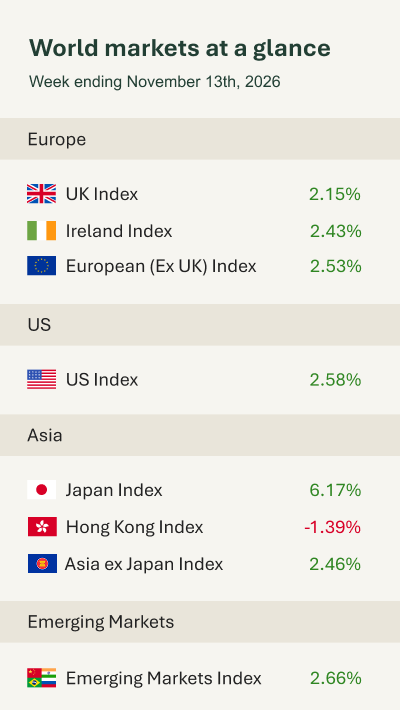
week ending 13th November 2026.

As you can see from the accompanying table, it was a much more positive week for global financial markets, with equities recovering following the previous week’s sell-off. Recent weeks have highlighted the importance of long-term investors holding their nerve amid market noise, with sentiment improving as investors returned to technology stocks and moderating oil prices provided some welcome relief.

On Monday in the U.S., the S&P 500 enjoyed its strongest daily performance in seven months, rising 2.35%, while the technology-heavy Nasdaq gained 2.74%. Although markets surrendered some of these gains towards the end of the week, all three major U.S. indices finished higher, demonstrating how quickly investor sentiment can shift.

Technology remained firmly in focus, particularly Nvidia, whose shares fell 13% over the week following the resignation of chief executive Jensen Huang. His departure followed reports of extramarital relationships, including one with a Chinese businesswoman suspected by U.S. intelligence officials of having links to Beijing. The allegations raised concerns surrounding corporate governance and national security, contributing to renewed selling in Nvidia shares. Nevertheless, the company’s established position within AI infrastructure and continued demand for its technology remain important underlying strengths. Despite the disruption, broader equity markets demonstrated resilience, highlighting the benefits of maintaining a diversified investment approach.

Oil prices also offered some welcome relief, with Brent crude falling to approximately $95 a barrel, around 18-20% below its level at the end of October. Easing geopolitical tensions and an improving balance between supply and demand helped alleviate concerns about renewed energy-driven inflation. Although shipping costs remain elevated and risks surrounding the Middle East persist, the moderation in oil prices is encouraging for businesses and consumers.

Meanwhile, U.S. inflation data painted a mixed picture. Consumer prices rose by more than expected in October, prompting Treasury yields to move higher and reinforcing market expectations that the Federal Reserve may need to raise interest rates again in December. However, while inflationary pressures remain persistent, policymakers will continue to monitor incoming economic data closely, particularly to assess the broader impact of higher energy prices on inflation, consumer spending, and overall economic growth.

Producer price inflation offered some relief, with prices rising 0.3% month-on-month, slightly below expectations. However, annual producer price inflation reached 6.5%, its highest level since 2022, highlighting the persistence of inflationary pressures.

Elsewhere, European equities participated in the recovery, with the STOXX 600 gaining 2.4%, supported by resilient corporate earnings and easing energy prices. Japanese equities performed particularly strongly, with the Nikkei rising 6.5% as a weaker yen and renewed enthusiasm for technology stocks supported sentiment. However, Chinese markets, struggled, particularly in Hong Kong, where technology-related selling weighed on performance.

The UK’s FTSE 100 gained more than 2% over the week, supported by stronger-than-expected economic data. The UK economy expanded by 0.7% in the third quarter, marking its fastest pace of growth in two years. Growth was driven primarily by the services sector, with AI-related businesses making an increasing contribution to economic activity.

Consumer spending remained relatively resilient despite ongoing headwinds, including higher energy prices and elevated interest rates linked to geopolitical tensions in the Middle East. Looking ahead, the UK remains on track to be one of the strongest-performing economies in the G7 over the third quarter, with growth expected to rank just behind that of the U.S.

Looking ahead, attention will remain on the technology sector, with Nvidia’s forthcoming earnings and developments surrounding the anticipated Anthropic IPO attracting interest. Investors will also be monitoring UK and eurozone inflation figures, industrial production data and Japan’s latest trade numbers.

Geopolitical developments will also be in focus as President Donald Trump attends meetings with ASEAN leaders in Manila before travelling to the APEC summit in China, where talks with President Xi Jinping are expected. Markets will be watching closely for developments in U.S.–China trade relations, particularly regarding tariffs, technology restrictions and the existing trade truce.

Kate Mimnagh, Portfolio Economist

The latest market updates are brought to you by Investment Managers & Analysts at Wealth at Work Limited which is a member of the Wealth at Work group of companies.

Links to websites external to those of Wealth at Work Limited (also referred to here as 'we', 'us', 'our' 'ours') will usually contain some content that is not written by us and over which we have no authority and which we do not endorse. Any hyperlinks or references to third party websites are provided for your convenience only. Therefore please be aware that we do not accept responsibility for the content of any third party site(s) except content that is specifically attributed to us or our employees and where we are the authors of such content. Further, we accept no responsibility for any malicious codes (or their consequences) of external sites. Nor do we endorse any organisation or publication to which we link and make no representations about them.