
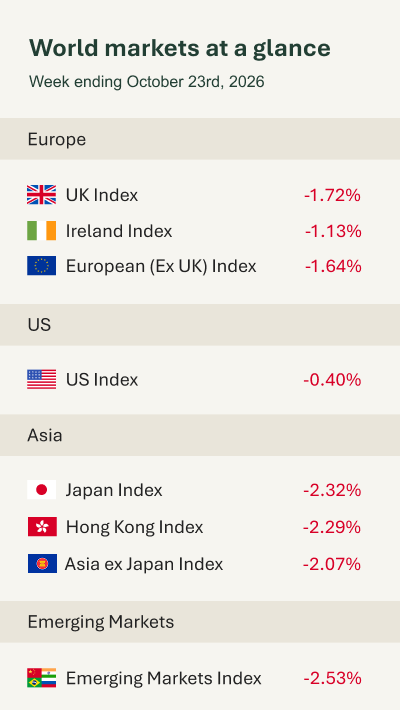
week ending 23rd October 2026.

Global markets finished the week under pressure as investors reconsidered the cost of artificial intelligence (AI) investment alongside higher energy prices and geopolitical risk. Renewed Houthi attacks in Saudi Arabia heightened fears of supply disruption, sending Brent crude above $116 a barrel by Friday’s close.

In the U.S., the sell-off was concentrated in technology, where investors are asking tougher questions about the scale of spending on data centres and semiconductors, and when it will generate returns. This is not the same as a collapse in demand for AI: many leading companies remain profitable and are reporting strong demand, although expectations embedded in share prices have been high. Other areas, including smaller companies and value stocks, performed better over the week. U.S. economic data also offered some reassurance. Initial jobless claims fell by 6,000 to 194,000 in the week ending 17th October, while continuing claims rose by 25,000. Layoffs therefore appear contained, although finding new work may be taking longer. U.S. business activity remained strong, even as surveys signalled rising selling prices, leaving the Fed alert to inflation risks.

In the UK, shares declined despite the market’s relatively low exposure to technology. September retail sales volumes fell 0.4%, partly because warm weather disrupted autumn clothing purchases, while higher fuel costs weighed on confidence. Despite some mixed signals, the overall picture was encouraging, with third-quarter sales up 0.7% and October’s services PMI at an eight-month high, supported by improving orders. The strength in business activity has increased the likelihood of a more cautious Bank of England stance.

European equities also weakened as higher energy prices and political unrest in France weighed on sentiment and government bonds. The eurozone composite PMI slowed to 51.9 in October from 53.1 in September, indicating continued, but more modest, growth.

At the same time, households’ expectations for inflation over the next year rose to 3.1% from 3.0%, while businesses faced higher energy-related costs. For the ECB, this creates a difficult trade-off: weaker activity argues for patience on further rate increases, but persistent price pressures leave little room to consider cuts. A hold at 2.5% at their meeting on the 29th October looks the likeliest outcome.

Across Asia, Japanese equities were particularly weak as the global semiconductor sell-off spread and rising oil prices added pressure on an energy-importing economy. Inflation also moved back above the Bank of Japan’s target. Chinese equities also fell; however, there were some encouraging economic signals, with third-quarter GDP growth improving to 4.5%. Nevertheless, weak household consumption and investment highlighted that the recovery remains uneven.

For investors, the rotation away from some of the largest technology names is a reminder of the value of diversification. There are legitimate questions over the returns from AI spending, but underlying demand, profitability and economic growth have not disappeared. Market setbacks can be uncomfortable without necessarily undermining a long-term investment strategy.

Looking to next week, the UK Autumn Budget on Wednesday 28th October will be closely watched for its impact on government borrowing and gilt yields, and we will provide an initial assessment of the market reaction. Central bank meetings will also be in focus, with the Federal Reserve expected to keep rates unchanged on 28th October, followed by the European Central Bank on 29th October, where rates are also expected to remain on hold. The Bank of Japan concludes its meeting on 30th October and is likely to maintain its current policy stance, although further tightening remains a possibility if inflation persists. U.S. GDP, PCE inflation and earnings from Microsoft, Alphabet and Amazon should provide further insight into the resilience of the U.S. economy and the returns being generated from AI investment.

Kate Mimnagh, Portfolio Economist

The latest market updates are brought to you by Investment Managers & Analysts at Wealth at Work Limited which is a member of the Wealth at Work group of companies.

Links to websites external to those of Wealth at Work Limited (also referred to here as 'we', 'us', 'our' 'ours') will usually contain some content that is not written by us and over which we have no authority and which we do not endorse. Any hyperlinks or references to third party websites are provided for your convenience only. Therefore please be aware that we do not accept responsibility for the content of any third party site(s) except content that is specifically attributed to us or our employees and where we are the authors of such content. Further, we accept no responsibility for any malicious codes (or their consequences) of external sites. Nor do we endorse any organisation or publication to which we link and make no representations about them.