
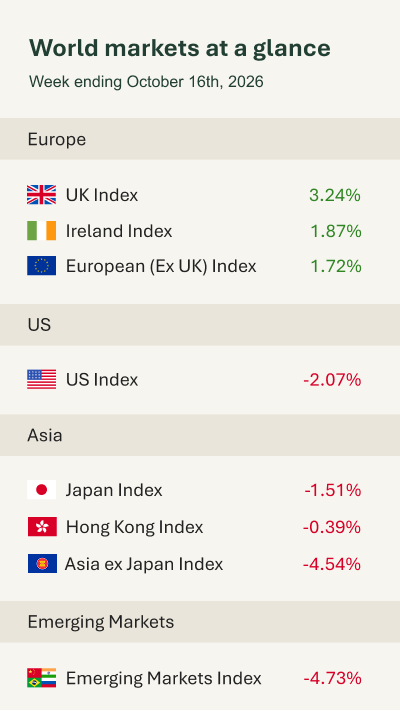
week ending 16th October 2026.

As you can see from the accompanying table, global equity markets delivered contrasting performances this week, with renewed selling in technology shares weighing heavily on Wall Street and parts of Asia, while UK and European equities proved more resilient. Concerns over the scale of investment in artificial intelligence, alongside persistent inflation and geopolitical uncertainty, dominated market sentiment.

In the U.S., the technology-heavy Nasdaq and the broader S&P 500 both eased back during the week as investors took the opportunity to reassess some of the market’s strongest-performing areas. Much of the focus remained on semiconductor and AI-related companies, with investors weighing the significant investment being made in AI infrastructure against the substantial long-term growth opportunities the technology could deliver.

While enthusiasm surrounding artificial intelligence remains a key driver of longer-term investment returns, recent market movements suggest investors are becoming more discerning, favouring companies with strong fundamentals and clear earnings visibility. With earnings season gathering pace, upcoming results will be closely watched to determine whether corporate profitability continues to support current valuations. We have seen similar periods of short-term volatility in the past, before investors ultimately looked to buy the dip. Maintaining a diversified approach and focusing on long-term investment objectives rather than short-term market noise is key.

U.S. inflation data was also in focus. The annual rate of inflation accelerated to 3.7% in September, exceeding expectations, while producer prices rose 6.3%, indicating continued pressure on business costs. Retail sales also increased, although higher fuel prices accounted for a significant proportion of the rise. Together, these figures complicated the outlook for Federal Reserve policy, with inflation remaining elevated despite signs of moderation in underlying consumer demand.

Interestingly, government bond markets provided some welcome stability towards the end of the week. Following the sharp rise in yields over recent weeks, investors returned to U.S. Treasuries and other government bonds as concerns over technology valuations increased. The U.S. 10-year Treasury yield fell to approximately 5.09% on Thursday. Falling yields, supported bond prices, helping to offset some of the volatility seen across equity markets.

Closer to home, the FTSE 100 gained 3.1%, recording its strongest weekly performance in six months and reaching a seven-week high on Thursday. The index benefited from its relatively limited exposure to technology companies, as investors moved towards more defensive sectors. Sentiment was also supported by Chancellor John Healey’s renewed commitment to fiscal discipline ahead of the Autumn Budget on the 28th October 2026. Although reports that the Chancellor could be considering higher taxes on the banking sector weighed on UK bank shares on Friday, investors took comfort from the government’s broader commitment to fiscal responsibility.

UK economic data offered further encouragement, with GDP expanding by 0.1% in August, against expectations of a modest contraction. Meanwhile, comments from Bank of England Governor Andrew Bailey indicated that there was currently limited evidence of higher energy costs feeding into more persistent domestic inflation, although he cautioned that risks would increase if elevated prices were sustained. Chief Economist Huw Pill also questioned whether financial markets had gone too far in pricing four interest rate increases over the coming year, suggesting that the extent of future tightening remains uncertain.

Elsewhere, European equities advanced, despite continued concerns surrounding energy costs and inflation. In Asia, Japanese stocks were weaker reflecting its significant exposure to semiconductor and technology stocks. Chinese equities also weakened, while Indian markets held up more favourably.

Oil prices remained elevated amid continued conflict in the Middle East and concerns over disruption to energy supplies. Brent crude traded around $110 a barrel, reinforcing the risk that higher energy costs could prolong inflationary pressures and complicate monetary policy decisions.

Looking ahead, attention will turn to UK inflation data, business activity surveys and further U.S. corporate earnings, particularly from major technology companies. Results from SpaceX and Netflix on Tuesday, followed by Meta Platforms and Tesla on Wednesday, will be closely watched for signs that economic growth remains resilient and that corporate earnings can continue to justify current market valuations.

Kate Mimnagh, Portfolio Economist

The latest market updates are brought to you by Investment Managers & Analysts at Wealth at Work Limited which is a member of the Wealth at Work group of companies.

Links to websites external to those of Wealth at Work Limited (also referred to here as 'we', 'us', 'our' 'ours') will usually contain some content that is not written by us and over which we have no authority and which we do not endorse. Any hyperlinks or references to third party websites are provided for your convenience only. Therefore please be aware that we do not accept responsibility for the content of any third party site(s) except content that is specifically attributed to us or our employees and where we are the authors of such content. Further, we accept no responsibility for any malicious codes (or their consequences) of external sites. Nor do we endorse any organisation or publication to which we link and make no representations about them.