

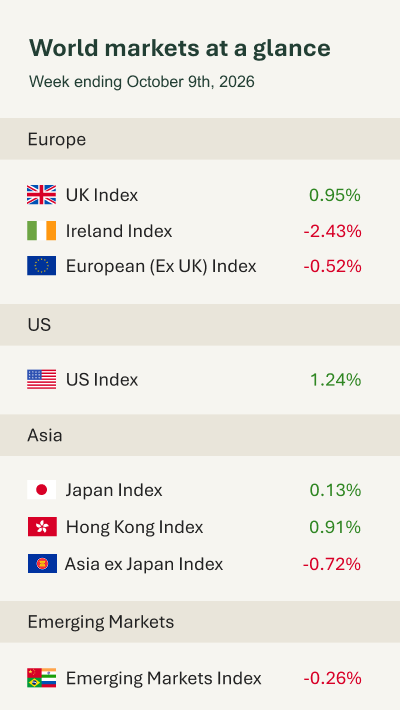
As you can see from the accompanying table, global equity markets delivered mixed returns last week, amid further volatility in oil prices, government bonds and technology shares. The US index gained 1.24%, while UK equities rose 0.95%, outperforming both broader European markets and Irish equities. Performance across Asia was mixed. Mainland Chinese shares declined in a holiday-shortened week following Golden Week, while Hong Kong equities advanced and Japanese stocks edged higher.
Markets got off to a positive start, helped by gains in technology shares, although higher borrowing costs remained a concern. US 10- and 30-year Treasury yields reached their highest levels since 2002 as investors weighed persistent inflation, government borrowing and the possibility of further interest rate increases. Bond yields, did retreat from their peaks as Treasury auctions attracted strong demand. Investment-grade corporate bonds also continued to draw buyers. While rising yields have put pressure on existing bond prices, they have improved the income available to investors, providing a stronger starting point for longer-term fixed income returns.
Wednesday’s minutes from the Federal Reserve’s September meeting where policymakers voted to raise interest rates by 0.25% revealed the decision was unanimous with most officials expecting another before year-end. They gave little indication that a move was necessary in October, however, leaving the Fed room to assess incoming data. Meanwhile, the US services sector continued to expand in September, although its survey of prices paid pointed to persistent inflationary pressure.
By Thursday, attention had turned to the Middle East. Brent crude briefly exceeded $105 a barrel after fresh attacks on tankers near the Strait of Hormuz, reversing an earlier fall following news of an accelerated release of oil reserves. The prospect of sustained high energy costs revived inflation concerns and weighed on global equities, particularly in Asia.