
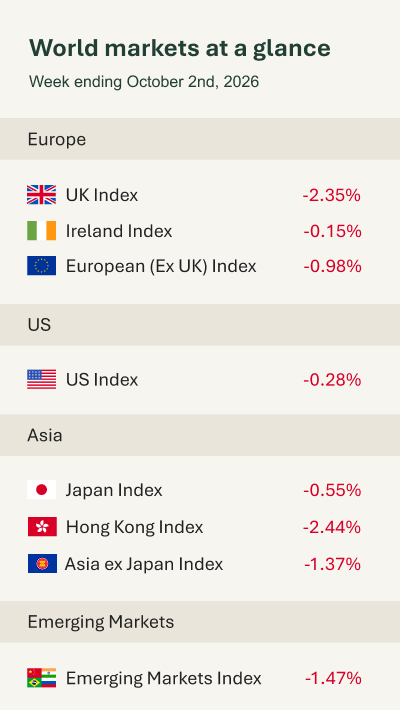
Week ending 2nd October 2026.

As you can see from the accompanying table, global financial markets were generally softer this week, as investors digested a further rise in government bond yields alongside economic data, corporate earnings and continued geopolitical uncertainty.

Much of the attention has been on bond markets. The US 10-year Treasury yield briefly reached 5.34% on Thursday, its highest level since 2002, while the 30-year yield moved towards 5.7%. In the UK, the 30-year gilt yield moved above 6% for the first time since 1998, with longer-term borrowing costs also rising across Europe and Japan.

So, why have yields risen?

There is no single trigger. Economic growth has remained relatively resilient; inflation is still above central-bank targets and higher energy prices have added uncertainty around the outlook for inflation and interest rates. Countries with higher debt burdens, such as Japan, have generally seen larger increases in bond yields, as investors demand greater compensation for lending to governments and absorbing substantial new debt issuance.

Higher yields do not, in themselves, mean there is a problem with government bond markets. Rather, markets are reassessing where interest rates, inflation and government borrowing may settle. Higher yields also increase the cost of new government borrowing and refinancing and can feed through into borrowing costs elsewhere in the economy, including mortgages and corporate finance.

For investors, however, bond yields are now among their most attractive levels in years, providing a much stronger source of income than has been available for much of the past decade. Our strategy of holding a diversified spread of financially secure companies with investment-grade credit ratings and stable income until they mature means that this price weakness, while understandably unsettling, shouldn’t be too concerning as maturity dates and values are known.

US economic data painted a picture of an economy that remains resilient, albeit with clearer signs of moderation. Core PCE inflation, the Federal Reserve’s preferred measure price pressures, rose by 0.2% in August, leaving the annual rate at 3.0%. Consumer spending also increased by a robust 0.9%, highlighting continued strength in household demand.

The labour market offered a softer signal. The US economy added just 29,000 jobs in September, well below expectations of 90,000, while unemployment edged up to 4.2%. Previous months were also revised lower and wage growth continued to slow, pointing towards a gradually cooling labour market. Treasury yields fell following the report as investors scaled back expectations for another Federal Reserve rate increase in October.

In Europe, inflation remains a challenge. Eurozone headline inflation rose to 3.8% in September from 3.2% in August, while core inflation edged up to 2.5%. Having already raised interest rates twice this year, the ECB continues to face a difficult balancing act between persistent inflation pressures and signs of softer growth.

Closer to home, the Labour Party conference at the start of the week generated relatively little immediate reaction from financial markets. A number of potentially significant longer-term proposals were discussed, including changes to the pension triple lock, greater scope for public ownership of water companies and a closer relationship with the European Union. Investors look ahead to the Budget on the 28th of October, for greater detail on tax, spending and borrowing.

Energy markets were also in focus towards the end of the week. G7 nations agreed to release up to 100 million barrels of diesel and crude oil from strategic reserves in an effort to ease pressure on global fuel markets. This comes as Chinese refiners have suspended oil-product exports for October as Beijing seeks to preserve domestic supplies. In the wake of the agreement, US President Donald Trump announced that he would no longer pursue a ban on diesel exports, helping to alleviate concerns over supply constraints.

Coming up next week, US ISM services PMI, Eurozone retail sales and US balance of trade. Federal reserve meeting minutes and University of Michigan consumer sentiment.

Kate Mimnagh, Portfolio Economist

The latest market updates are brought to you by Investment Managers & Analysts at Wealth at Work Limited which is a member of the Wealth at Work group of companies.

Links to websites external to those of Wealth at Work Limited (also referred to here as 'we', 'us', 'our' 'ours') will usually contain some content that is not written by us and over which we have no authority and which we do not endorse. Any hyperlinks or references to third party websites are provided for your convenience only. Therefore please be aware that we do not accept responsibility for the content of any third party site(s) except content that is specifically attributed to us or our employees and where we are the authors of such content. Further, we accept no responsibility for any malicious codes (or their consequences) of external sites. Nor do we endorse any organisation or publication to which we link and make no representations about them.