

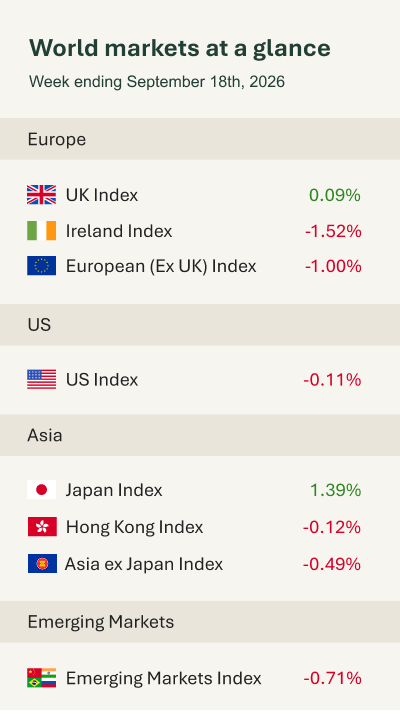
As shown in the accompanying table, it was a mixed week for global financial markets. Japan led gains, while the UK delivered a modest positive return. Most other regions declined, while the US was broadly flat.
It was a busy week for central banks, with policymakers in the US, UK and Japan all announcing interest-rate decisions. While the outcomes were broadly in line with market expectations, the backdrop of persistent inflation, higher energy prices and geopolitical uncertainty continued to weigh on sentiment, leaving global equity performance uneven.
In the US, the Federal Reserve raised interest rates by 0.25% on Wednesday, taking the federal funds target range to 3.75%–4.00%. This marked the Fed’s first-rate increase in more than three years and was unanimously supported by policymakers. Chair Kevin Warsh stressed that inflation remained too high and had done so for too long, with the Fed seeking to bring inflation back towards its 2% target.
The decision highlights the difficult balancing act facing policymakers. Much of the recent inflationary pressure has been linked to higher energy prices, which conventional monetary policy has limited ability to directly address. The Fed’s move followed the European Central Bank’s decision earlier in the month to raise rates for the second time this year. Nevertheless, the US economy has remained relatively resilient. August retail sales rose by a stronger-than-expected 1.2%, demonstrating continued consumer demand despite higher fuel prices and broader cost pressures.
US equity markets were initially supported by stronger-than-expected retail sales data but lost momentum following the Federal Reserve’s announcement. Meanwhile, bond yields eased from their recent highs, helping to reinforce investor confidence in the Fed’s commitment to controlling inflation. The dot plot, which reflects individual policymakers’ expectations for the future path of short-term interest rates, indicated that most Fed officials expect at least one further rate hike before year-end.