
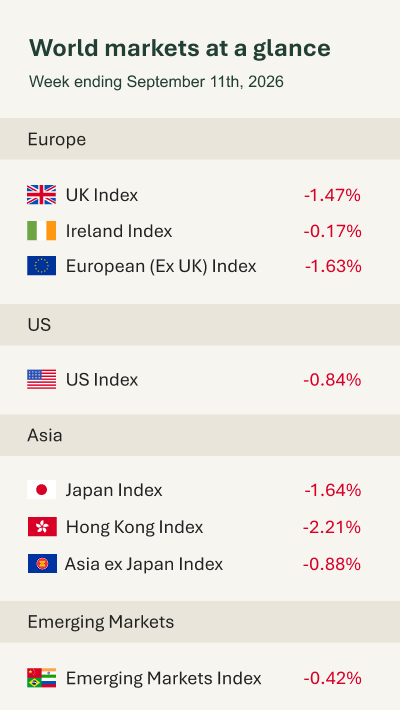
Week ending 11th September 2026.

As you can see from the accompanying table, global equity markets were generally lower over the week, with geopolitical developments, rising energy prices, and changing expectations for interest rates weighing on sentiment.

Geopolitics remained the main driver of markets. Brent crude rose above $100 a barrel, briefly nearing $110 as tensions between the U.S. and Iran escalated and Iran-aligned Houthi forces seized Yemen’s port of Mocha. Concerns over disruption to Red Sea shipping and continued restrictions in the Strait of Hormuz pushed prices higher. Brent settled at around $104.50 on Friday, below its intraweek peak but still sharply higher on the week.

The rise in energy prices added to concerns that inflation could remain elevated for longer, prompting investors to increase expectations for further interest rate rises. This was reflected across global bond markets, where government bond prices fell and yields moved higher. In the UK, the yield on the benchmark 10-year gilt rose to around 5.4%, its highest level since 2007. Similar moves were seen in the U.S., where the yield on the benchmark 10-year Treasury briefly approached 5%, highlighting the sensitivity of bond markets to changing expectations for inflation and monetary policy.

Against this backdrop, the European Central Bank raised its three key interest rates by 0.25% on Thursday, taking the deposit rate to 2.50%. The ECB acknowledged that higher energy costs continue to add to inflationary pressures and revised its inflation forecasts higher for both 2027 and 2028. Policymakers also noted that inflation could prove stickier than previously anticipated, reinforcing expectations that monetary policy may need to remain restrictive for longer. However, there was also some encouragement in the economic outlook, with growth forecasts for 2026 and 2027 upgraded following greater-than-expected resilience across the euro area. Policymakers stressed that uncertainty remains elevated, with risks tilted towards higher inflation and weaker growth depending on how the energy shock develops. As the rate increase was largely priced in by markets, the immediate reaction was relatively muted.

There was also some more positive economic news from the UK. The economy expanded by 0.4% month-on-month in July, ahead of expectations for no growth and following a 0.3% increase in June. Services provided the largest contribution, with particularly strong activity in areas linked to artificial intelligence, cloud computing and computer programming. The economy continues to show greater resilience than anticipated despite higher energy costs and borrowing rates. This resilience may allow the Bank of England to remain patient before making its next move.

U.S. equity markets also ended the holiday-shortened week lower, although stocks recovered some ground on Friday as oil prices eased from their highs. U.S. inflation data strengthened expectations for a further Federal Reserve rate rise. Producer prices rose 0.4% month-on-month in August and 5.4% year-on-year, with higher goods and energy prices accounting for much of the increase. On Friday, the final consumer inflation report ahead of the Federal Reserve’s meeting on 15–16th September provided further evidence that price pressures remain persistent. Headline CPI rose 3.4% year-on-year in August and 0.4% from July, broadly in line with expectations, with higher energy costs contributing to the increase. Core CPI, which excludes volatile food and energy prices, rose 0.3% month-on-month, slightly ahead of forecasts, while the annual rate remained at 2.4%.

Taken together, the inflation data and higher oil prices have strengthened expectations of a 0.25% Federal Reserve rate increase. While a hike is not assured, market pricing has shifted materially in that direction, placing greater emphasis on whether policymakers see the recent inflation pickup as an energy-driven shock or a sign of more persistent underlying price pressures.

Looking ahead to next week, attention will remain firmly on central banks. The Federal Reserve concludes its meeting on Wednesday 16th September, with markets now leaning heavily towards a 0.25% rate rise. The Bank of England meets on Thursday 17th September, with Bank Rate currently at 3.75% and policymakers widely expected to leave rates unchanged while assessing the impact of the latest rise in energy costs. The Bank of Japan concludes its meeting on Friday 18th September, with markets expecting a 0.25% increase from 1.00% to 1.25% amid continued concerns over inflationary pressures and the yen.

Kate Mimnagh, Portfolio Economist

The latest market updates are brought to you by Investment Managers & Analysts at Wealth at Work Limited which is a member of the Wealth at Work group of companies.

Links to websites external to those of Wealth at Work Limited (also referred to here as 'we', 'us', 'our' 'ours') will usually contain some content that is not written by us and over which we have no authority and which we do not endorse. Any hyperlinks or references to third party websites are provided for your convenience only. Therefore please be aware that we do not accept responsibility for the content of any third party site(s) except content that is specifically attributed to us or our employees and where we are the authors of such content. Further, we accept no responsibility for any malicious codes (or their consequences) of external sites. Nor do we endorse any organisation or publication to which we link and make no representations about them.