

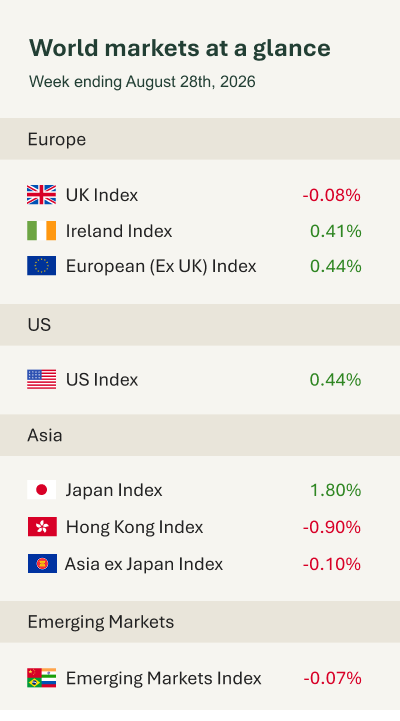
As shown in the accompanying table, it was a mixed week for global financial markets, with investors focused on the latest U.S. inflation data, developments in the Middle East, and a closely watched set of results from tech giant Nvidia.
The Federal Reserve’s preferred measure of inflation, the Personal Consumption Expenditures (PCE) price index, was released mid-week. Inflation rose broadly in line with expectations, although consumer spending slowed. The annual rate of PCE inflation increased to 3.7%, while core PCE, which excludes the more volatile food and energy components, rose 3.3% year-on-year.
While the readings were relatively muted, inflation remains well above the Federal Reserve’s 2% target. At the same time, the economy remains resilient, consumer spending continues to hold up, and the labour market is showing signs of softening, creating a difficult balancing act for policymakers. With no Federal Open Market Committee meeting scheduled in August, attention has already turned to the 15-16 September meeting and any further clues on the timing and pace of future interest rate adjustments.
Against this backdrop, investors closely followed the Jackson Hole Economic Symposium in Wyoming, where Fed Chair Kevin Warsh delivered a much-anticipated speech on Friday. While the speech struck a hawkish tone and reinforced the Fed’s commitment to returning inflation to target, investors largely viewed the message as supportive. Warsh stated that policymakers “must be confident that underlying inflation is moving towards their objective with sufficient speed, otherwise there is work to do”, underlining the Fed’s focus on price stability.
Warsh stated that current financial conditions are difficult to describe as restrictive, leaving the Fed room to tighten policy further if inflation does not decline. He also noted that he was “impressed” by the economy’s overall performance, which appears to have strengthened recently.