

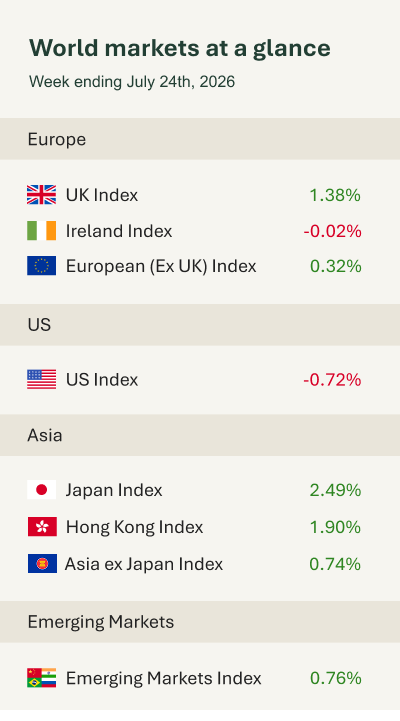
Market returns were broadly positive across regions, although US equities lagged and Ireland finished marginally lower. Investors digested a generally strong earnings season. However, higher oil prices, concerns about elevated technology investment, and renewed trade tensions contributed to a more cautious market tone.
US stocks closed the week lower whilst corporate earnings provided a mixed picture. Although many companies continued to report solid results, several large technology firms came under pressure as investors questioned whether the pace of spending on artificial intelligence will generate sufficient returns. Both Tesla and Google’s parent company Alphabet fell even after reporting strong second-quarter revenues.
However, investors focused on their capital expenditure plans, reflecting continued sensitivity to valuations and the potential impact of higher spending on future profitability.
Trade policy returned to the spotlight after President Donald Trump announced a new round of tariffs on 60 of the United States’ largest trading partners, including the UK, China, the European Union, Canada, Japan and India. The measures, ranging from 10% to 12.5%, replace the temporary 10% global tariff that expired this week.
The US administration says the tariffs are aimed at strengthening enforcement against forced labour. However, these concerns are not generally seen as relevant to countries such as the UK and much of Europe, which have nonetheless been included in the broader package. Markets have become increasingly desensitised to tariff announcements, and these measures are less extensive than many had feared. With trade negotiations continuing across several key relationships, there remains potential for further changes in the months ahead.