
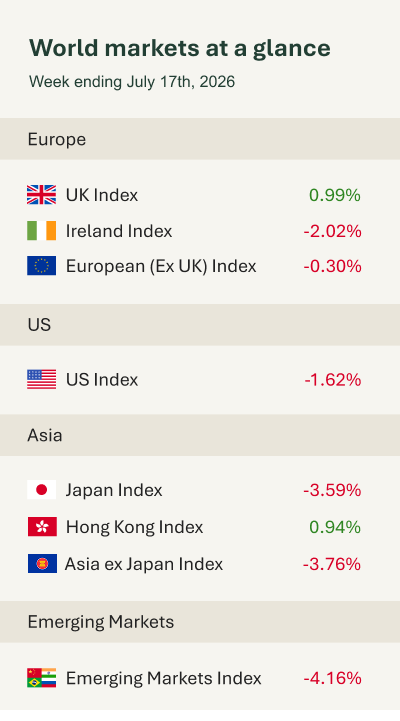
Week ending 17th July 2026.

It was an eventful week for markets, with investors digesting a busy calendar of second-quarter earnings, economic data and rising geopolitical tensions. While technology companies delivered another round of impressive earnings, tech stocks nevertheless pulled back, weighing on US and Asian markets. Meanwhile, the UK’s FTSE 100, with relatively limited technology exposure, rose 0.98%.

Geopolitical developments remained a key focus for investors as the United States intensified its military campaign against Iran. President Donald Trump stated that airstrikes would continue until Tehran ceases attacks on commercial shipping. Meanwhile, Iran’s closure of the Strait of Hormuz, a strategically important route that typically handles around a fifth of global oil shipments, has raised concerns about potential disruptions to energy markets.

Brent crude oil prices remained elevated, with futures settling at $88.10 per barrel on Friday. Prices, remain below the peaks reached during the earlier stages of the conflict, suggesting that markets have not yet priced in a prolonged supply disruption.

However, while uncertainty remains, the situation is highly dynamic, and (as recent history has shown) diplomatic breakthroughs or ceasefire agreements can emerge unexpectedly. The outlook could improve rapidly should tensions begin to ease.

Despite the uncertain backdrop, the second-quarter earnings season got off to an impressive start, with several of the largest US banks comfortably surpassing expectations.

JPMorgan Chase reported the largest quarterly profit ever recorded by a US bank, benefiting from strong equity trading revenues alongside gains from its Visa shareholding. Goldman Sachs also delivered record results as investment banking revenues surged amid a recovery in dealmaking activity and continued demand for AI-related investment. Collectively, the results suggest that activity across financial markets remains healthy despite elevated interest rates and heightened geopolitical uncertainty.

The strong results from TSMC, the world’s largest contract semiconductor manufacturer, and ASML, the leading supplier of advanced chipmaking equipment, provide further evidence that the global AI investment cycle remains firmly intact.

TSMC posted record Q2 results, driven by booming AI demand, and raised its full-year growth forecast. ASML beat market expectations for its Q2 2026 financial results and raised its full-year guidance.

Despite strong earnings and robust AI-driven demand, TSMC and ASML shares declined as investors reacted cautiously to TSMC’s increased capital expenditure plans and ongoing concerns around ASML’s geopolitical export restrictions and rising costs. The broader technology and semiconductor sectors also came under pressure, reflecting profit-taking after strong year-to-date gains and investor concerns over whether future earnings growth can justify current valuations. Market weakness across Asia suggested the sell-off was driven more by concerns over spending levels and valuation sustainability than by any deterioration in underlying demand.

Away from company earnings, economic data painted a more mixed picture.

In the UK, the economy returned to growth in May, expanding by 0.1% after a slight contraction in April. While the data suggest economic activity remains positive, we continue to expect growth to remain below trend in the second half of the year, with any sustained rise in oil prices posing a material downside risk. The latest figures are unlikely to materially alter the Bank of England’s policy stance.

Meanwhile, Andy Burnham officially became leader of the governing Labour Party on Friday and is set to become Prime Minister on 20 July. Market reaction has so far been muted, reflecting a wait-and-see approach among investors.

China’s second-quarter GDP growth slowed to 4.3% year-on-year, below both market expectations and the government’s target range. There were, however, some encouraging signs beneath the surface. Industrial production accelerated to 5.3% in June, supported by stronger manufacturing output and resilient demand for AI-related exports, while retail sales unexpectedly returned to growth after contracting in May.

Looking ahead to next week, the Q2 earnings season continues. In the UK, key releases include unemployment, average earnings and inflation data. In Europe, the European Central Bank is expected to keep interest rates unchanged at 2.25%, with investors closely watching policymakers’ commentary for clues on the policy outlook. Later in the week, attention will turn to retail sales figures and Eurozone PMI data, which will provide further insight into the region’s economic momentum.

Kate Mimnagh, Portfolio Economist

The latest market updates are brought to you by Investment Managers & Analysts at Wealth at Work Limited which is a member of the Wealth at Work group of companies.

Links to websites external to those of Wealth at Work Limited (also referred to here as 'we', 'us', 'our' 'ours') will usually contain some content that is not written by us and over which we have no authority and which we do not endorse. Any hyperlinks or references to third party websites are provided for your convenience only. Therefore please be aware that we do not accept responsibility for the content of any third party site(s) except content that is specifically attributed to us or our employees and where we are the authors of such content. Further, we accept no responsibility for any malicious codes (or their consequences) of external sites. Nor do we endorse any organisation or publication to which we link and make no representations about them.