

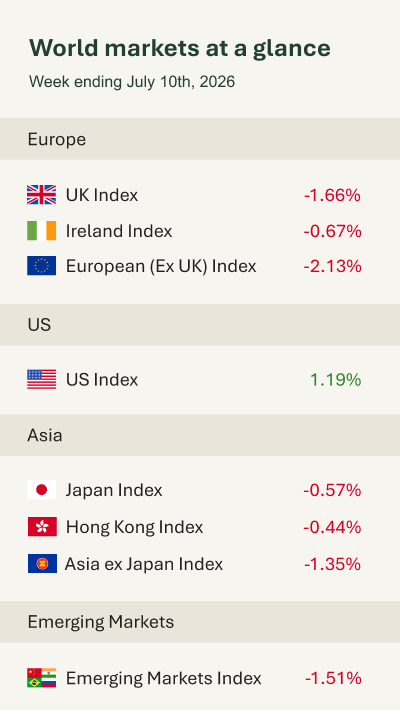
As shown in the accompanying table, markets closed the week on a mixed footing.
With economic data relatively light and investors awaiting the start of the second-quarter earnings season, it had been shaping up to be a relatively quiet week. However, markets were once again forced to navigate a fresh bout of geopolitical uncertainty as tensions between the United States and Iran intensified. On Wednesday, US President Donald Trump declared the ceasefire agreement with Iran to be over, stating at the NATO summit in Turkey that he “didn’t want to deal with them anymore”.
The collapse of the ceasefire and renewed military exchanges raised concerns that the conflict could escalate further and disrupt global energy supplies. Iran resumed attacks on commercial shipping in the Strait of Hormuz, while the US launched additional strikes and tightened sanctions on Iranian oil exports. These developments briefly pushed oil prices (Brent Crude) around 5% higher to approximately $80 per barrel before settling at $76 by Friday. However, it is worth noting that crude prices remain significantly below the highs of $120 reached earlier in the year and only modestly above pre-conflict levels.
While recent developments have unsettled investors, they have not come as a major surprise. This type of brinkmanship is characteristic of President Trump’s negotiating style, and markets have already weathered several cycles of escalation and de-escalation this year. Despite the geopolitical noise, equity markets have delivered strong returns and demonstrated notable resilience. Oil prices have also retreated, remaining within a historically normal range and providing some short-term relief.
Based on how the conflict has evolved so far, further periods of heightened tensions and renewed fighting before another ceasefire would not be surprising. As we often remind investors, periods of market dislocation can create attractive opportunities for those with a long-term investment horizon. This year’s events have reinforced the view that geopolitical uncertainty, while unsettling in the short term, is not something long-term investors should fear.