
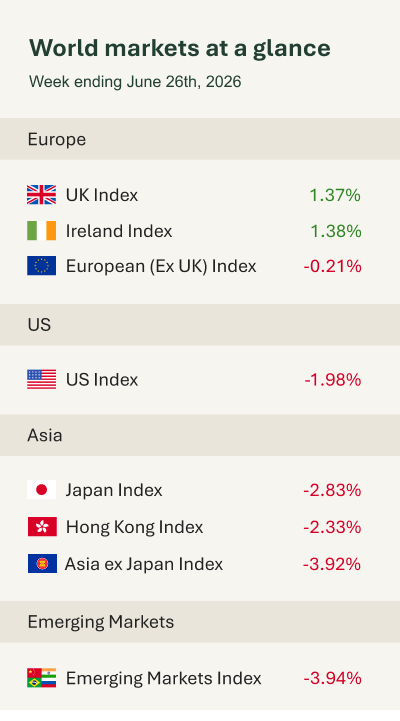
Week ending 26th June 2026.

As you can see from the accompanying table it was a choppy week for global financial markets, as investors digested earnings in technology companies and falling oil prices.

Data wise, US inflation rose to the upside in May, with headline PCE rising to 4.1% year on year, its first move above 4% in three years, largely driven by higher energy prices linked to Middle East tensions. Core PCE, which excludes volatile food and energy, increased by 3.4% year on year, remaining well above the Fed’s 2% target.

Whilst oil prices in the US have since retreated to pre-conflict levels following a preliminary US–Iran agreement, pointing to likely easing in gasoline costs, previous higher energy costs are still filtering through to broader prices. Against this backdrop, the Fed has kept its policy rate unchanged at 3.50%–3.75% and has left an interest rate hike firmly on the table for now. Policymakers will continue to assess incoming inflation data in the weeks and months ahead, with markets now starting to price in the likelihood of a 25-basis point hike in September.

UK and European markets outperformed many of their global peers. Broader European indices were largely shielded from the technology-led sell-off, reflecting their comparatively lower exposure to AI-related stocks.

Despite political uncertainty hitting the UK on Monday following the resignation of Prime Minister Keir Starmer. The Labour Party will now choose a new leader, currently expected to be Andy Burnham. Despite the uncertainty, the UK’s FTSE 100 closed the week up over 1%, as investors continue to focus on the broader macro backdrop and continue to look for greater clarity on the future direction of fiscal and economic policy.

In Japan, Prime Minister Sanae Takaichi unveiled an ambitious long-term investment strategy aimed at boosting the country’s industrial competitiveness. The plan proposes approximately 370 trillion yen (around $2.3 trillion) of public and private investment, including artificial intelligence and semiconductors. The initiative underscores Japan’s commitment to strengthening economic security and positioning itself at the forefront of next-generation technologies.

Sentiment shifted as investors rotated away from high-growth technology stocks towards more defensive sectors. After months of AI-driven gains, semiconductor and technology shares came under pressure as investors questioned elevated valuations and the pace of returns from significant AI infrastructure investment.

Sentiment was further dampened after Apple indicated that rising memory and storage chip costs would necessitate higher prices for selected iPad and MacBook models, while Microsoft announced price increases for its Xbox consoles. Although periods of profit-taking have become a recurring feature of the AI investment cycle, investor demand for high-quality businesses has historically bounced back quickly following sell offs.

Commodity markets were also in focus. Oil prices declined with brent crude falling to ~$72 per barrel as concerns over supply disruptions eased and shipping through the Strait of Hormuz continued largely uninterrupted. Lower crude prices helped improve the inflation outlook and supported government bond markets by reducing expectations of sustained price pressures.

However, sentiment deteriorated towards the end of the week after renewed reports of attacks on commercial vessels and fresh accusations between the US and Iran of breaching the recently agreed ceasefire. While the agreement reached on 17th June remains in place, the situation remains fragile. For investors, intermittent geopolitical flare-ups are likely to continue until a more durable settlement is achieved. Encouragingly, the continued operation of key shipping routes and repeated efforts to avoid further escalation suggest that the risk of a prolonged disruption to global energy supplies remains contained.

Looking ahead, investors will focus on the latest US employment report, global manufacturing PMI surveys, Eurozone inflation and economic sentiment indicators.

Kate Mimnagh, Portfolio Economist

The latest market updates are brought to you by Investment Managers & Analysts at Wealth at Work Limited which is a member of the Wealth at Work group of companies.

Links to websites external to those of Wealth at Work Limited (also referred to here as 'we', 'us', 'our' 'ours') will usually contain some content that is not written by us and over which we have no authority and which we do not endorse. Any hyperlinks or references to third party websites are provided for your convenience only. Therefore please be aware that we do not accept responsibility for the content of any third party site(s) except content that is specifically attributed to us or our employees and where we are the authors of such content. Further, we accept no responsibility for any malicious codes (or their consequences) of external sites. Nor do we endorse any organisation or publication to which we link and make no representations about them.