
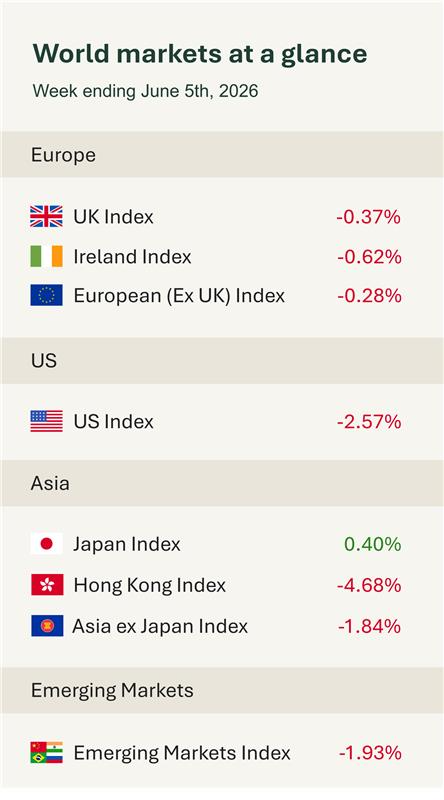
Week ending 5th June 2026.

Geopolitical developments remained firmly in focus this week, with progress on Middle East peace negotiations proving uneven, marked by intermittent progress followed by setbacks. While markets have largely avoided panic, uncertainty surrounding the conflict have continued to cloud the outlook, particularly for inflation and future interest rate expectations.

In the U.S. the Republican-led House narrowly voted to limit further U.S. military action against Iran, reflecting growing concern across both political parties regarding the economic consequences of the conflict. Rising energy prices, inflation, and weaker consumer confidence have increased political sensitivity ahead of next year’s midterms. While largely symbolic, the vote highlights growing political divisions. A Republican loss in the midterms could reduce Trump’s ability to advance his policy agenda, which markets may view positively.

Market attention also remained focused on U.S. labour market data and business activity surveys, both closely monitored by the Federal Reserve. The latest employment report pointed to ongoing resilience in the labour market, with nonfarm payrolls rising by 172,000 in May, comfortably ahead of expectations for around 80,000. Employment growth was led by the leisure, hospitality, local government, and healthcare sectors, while the unemployment rate remained unchanged at 4.3%.

The stronger-than-expected payrolls data suggest labour market conditions remain healthy despite moderating economic activity. The report is likely to reinforce the Federal Reserve’s patient approach to monetary policy, reducing pressure for near-term interest rate cuts.

Trade policy also returned to the forefront. The Office of the U.S. Trade Representative proposed potential tariffs of up to 12.5% on countries deemed to be inadequately preventing imports linked to forced labour. While still subject to consultation, the European Union and UK responded firmly, underscoring the risk of renewed trade tensions.

U.S. business surveys signalled continued economic resilience, with both ISM manufacturing and services PMIs beating expectations on solid new orders.

Overall, the data suggest growth is holding up better than anticipated despite lingering cost pressures.

Tech earnings provided another important talking point. Broadcom Inc. (a U.S. semiconductor and infrastructure software company) shares fell sharply after guidance failed to meet elevated expectations for AI-related growth. The reaction highlighted how sensitive the technology sector’s sentiment remains to even modest disappointments.

Growth in Europe was revised lower, with the euro area now estimated to have contracted 0.2% in the first quarter of 2026. The downgrade was driven by a sharp 12.1% drop in Irish GDP, reflecting volatility tied to multinational activity. Excluding Ireland, the region looks more resilient, aligning with the ECB’s view that underlying conditions remain stable. Even so, high inflation, elevated energy costs and softer business activity continue to weigh on the recovery.

Looking ahead, the ECB is expected to raise its deposit rate by 0.25% to 2.25% on 11th June, as it seeks to balance persistent energy-driven inflation against signs of a weakening economic backdrop. Still also to come later this week; Chinese balance of trade, U.S. inflation and U.S. PPI, UK GDP, and University of Michigan consumer sentiment.

Nicola Tune, Portfolio Specialist

The latest market updates are brought to you by Investment Managers & Analysts at Wealth at Work Limited which is a member of the Wealth at Work group of companies.

Links to websites external to those of Wealth at Work Limited (also referred to here as 'we', 'us', 'our' 'ours') will usually contain some content that is not written by us and over which we have no authority and which we do not endorse. Any hyperlinks or references to third party websites are provided for your convenience only. Therefore please be aware that we do not accept responsibility for the content of any third party site(s) except content that is specifically attributed to us or our employees and where we are the authors of such content. Further, we accept no responsibility for any malicious codes (or their consequences) of external sites. Nor do we endorse any organisation or publication to which we link and make no representations about them.