

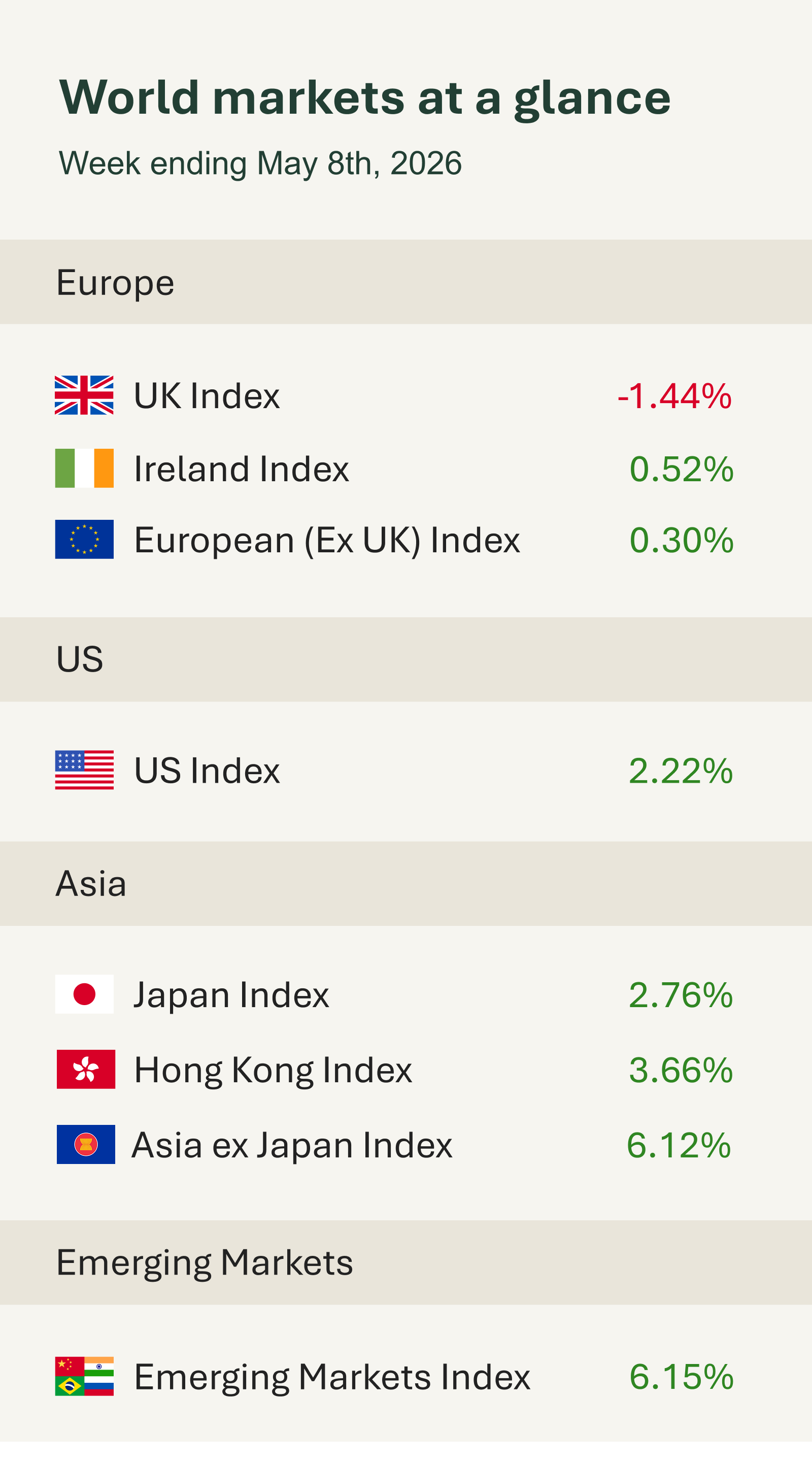
As can be seen from the accompanying table, markets broadly ended the week in the green.
Traders noted that tariffs once again became a key talking point for Donald Trump during the week. He announced that he would extend the European Union’s trade deadline with the US to meet what he considers to be the Union’s obligations with the US. These included the EU committing to purchasing $750 billion worth of U.S. energy, investing an additional $600 billion into the U.S. economy above current levels, and removing tariffs on U.S. goods entirely. Trump warned that if European policymakers fail to act quickly before the revised deadline of the 4th of July, he will look to impose steeper tariffs on the bloc. And yet, this may prove difficult for him, following a recent ruling by a U.S. trade court that Trump’s latest 10% global tariffs were not justified under U.S. law.
Peace talks between the US and Iran are ongoing. Earlier this week, reports suggested Iran was reviewing a fourteen-point US memorandum while continuing to obstruct the Strait. On Sunday, Iranian President stopped short of directly addressing Tehran’s proposal but stated: “if talk of dialogue or negotiation arises, it does not mean surrender or retreat.” Shortly afterwards, Trump cryptically described Iran’s response as “unacceptable.” For now, much of the speculation remains just that: speculation. Traders are still hanging their hats on that a resolution can be reached once substantive, direct negotiations get underway, rather than the current cycle of indirect messaging and social media exchanges.
Data in the US revealed the labour market remains resilient, with the economy adding 115,000 jobs in April. The unemployment rate held steady at 4.3%.
The UK political landscape came into focus this week as the Labour Party suffered the widely expected losses at the polls, highlighting potential growing dissatisfaction with Prime Minister Keir Starmer and his leadership. Concerns had emerged among investors that increased political pressure on Starmer to step aside (potentially opening the door to a more fiscally expansionary successor) could unsettle bond markets. However, in a speech following the results, Starmer firmly dismissed speculation about his resignation and reiterated his commitment to serving out the remainder of his five-year term. His comments appeared to reassure markets, with yields on 10-year UK government bonds moving lower by Friday morning as investor nerves eased.
Japan’s real wages rose 1% year‑on‑year in March, boosted by the Shunto wage negotiations, which delivered over 5% pay increases for a third year. Nominal pay, base salaries, and overtime all climbed, signalling stronger domestic income growth.