

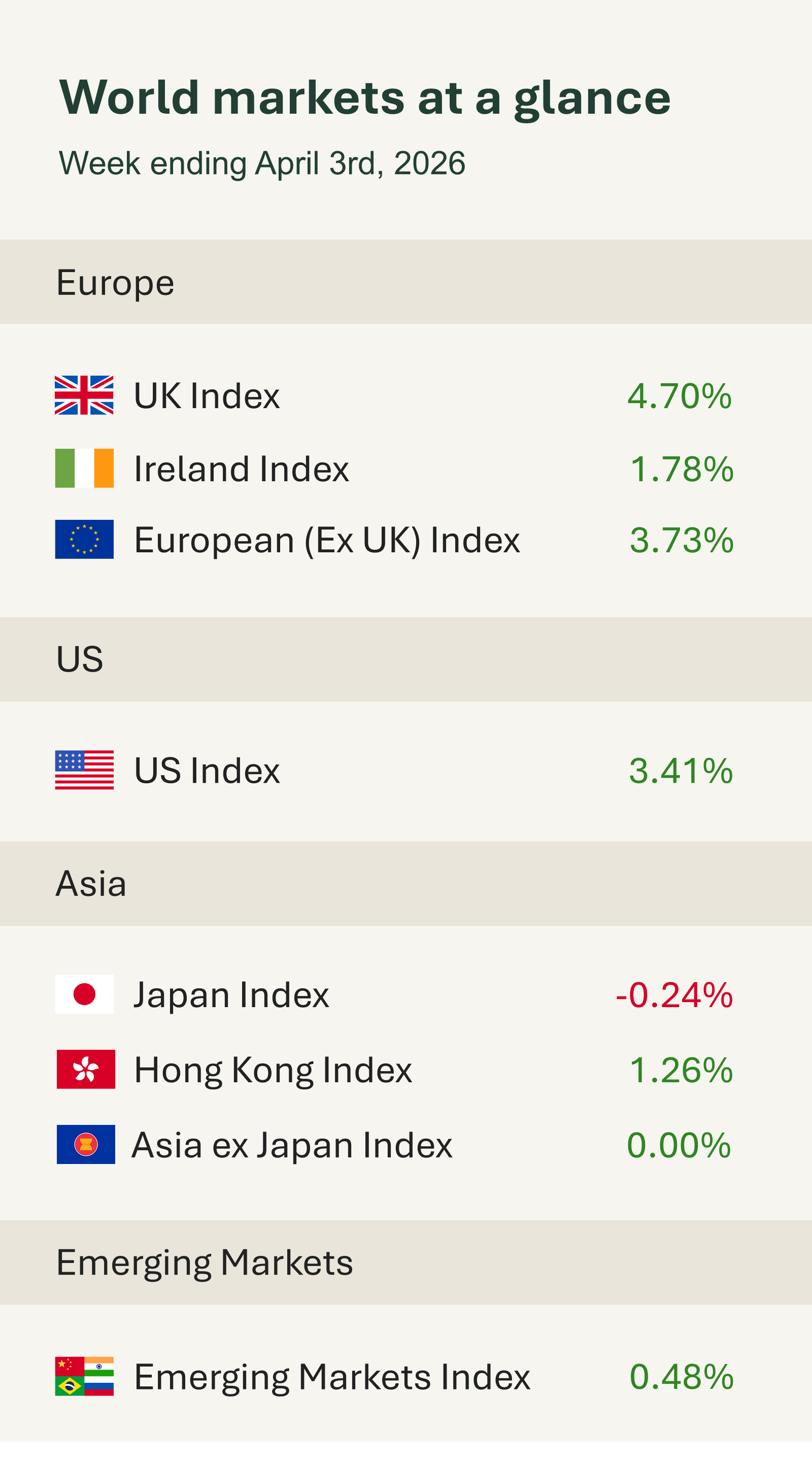
As you can see from the accompanying table it was a more positive albeit short week for global financial markets with markets across the U.S., UK and Europe closed on Friday in observance of the Good Friday holiday.
Major U.S. indices closed the week 3%-4% higher. Whilst over in the UK and Europe the FTSE 100 rose 4.70% and Eurostoxx 3.92%.
Market sentiment remained under pressure amid heightened tensions in the Middle East. Mixed signals from President Donald Trump and conflicting statements from Iranian officials, including little indication of a willingness to pursue a ceasefire, kept uncertainty elevated. Sentiment weakened again following a Wednesday evening address that warned the U.S. would hit Iran “extremely hard over the next two to three weeks.” This reinforced expectations of further escalation, pushing oil prices sharply higher and weighing on equities into Thursday. Despite this volatility, markets ultimately looked through the renewed uncertainty and recovered into the end of the week.
Energy remained the dominant macro driver. Price movements reflected ongoing uncertainty around the Strait of Hormuz, a key transit route through which roughly a fifth of global oil and liquefied natural gas flows typically pass. Brent crude was trading around $112 per barrel on Friday.
The impact of the disruption is most acute in Asia, where economies remain heavily reliant on energy flows through the Strait and are therefore more exposed to price shocks. By contrast, developed market equities proved more resilient. The UK’s FTSE 100 was supported by strength in energy and defensive sectors and, despite March volatility, remains up around 5% year‑to‑date, indicating that recent gains have offset earlier weakness.
For the UK, the implications of Hormuz‑related disruption are largely price‑driven rather than supply‑driven. The energy system is highly diversified, supported by North Sea production, pipeline imports from Norway, interconnectors with continental Europe and three LNG terminals. Reliance on any single supplier is limited, with only around 1% of gas supply in 2025 sourced from Qatar.