

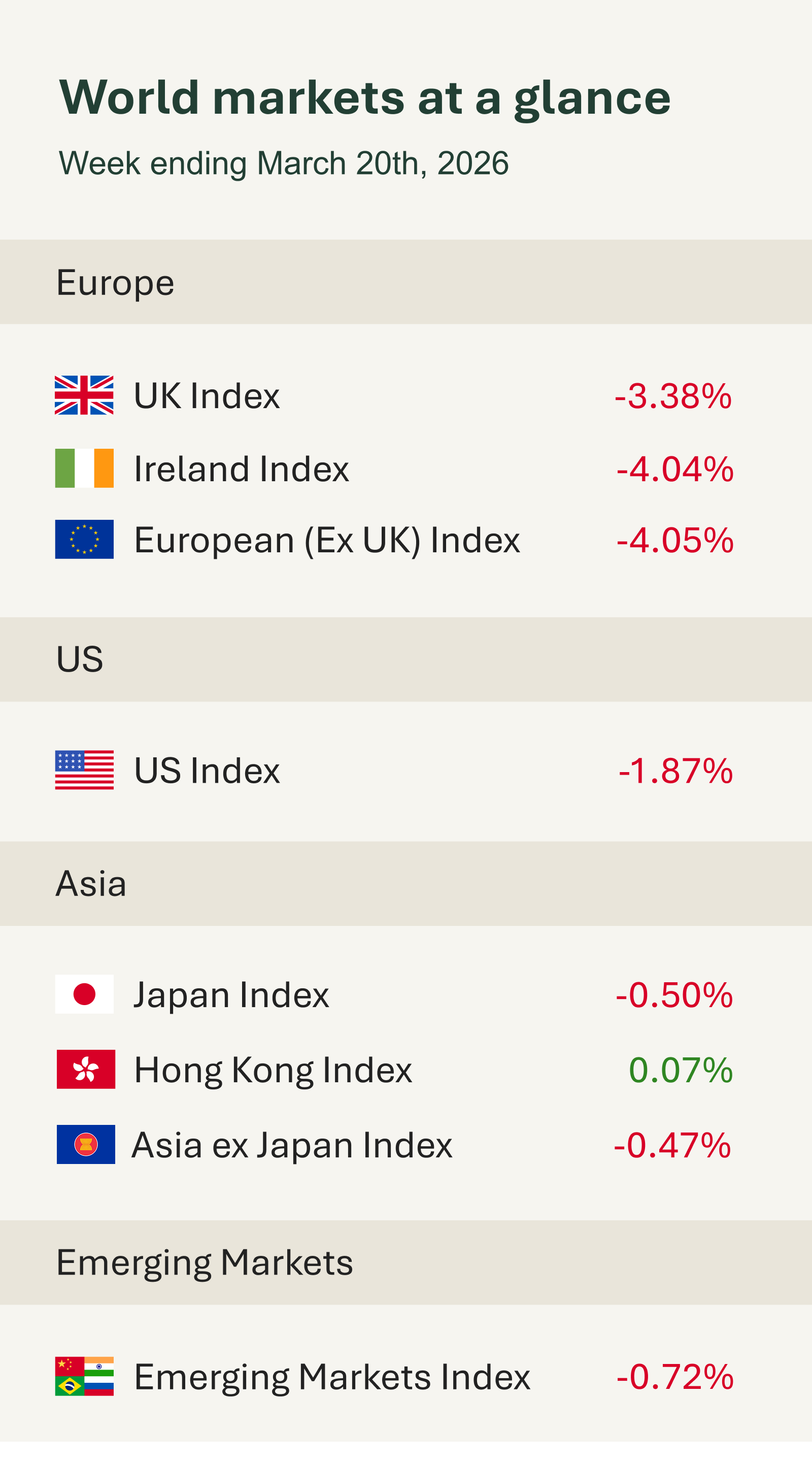
As you can see from the accompanying table markets remained on edge over the week which was packed with war headlines and central bank interest rate decisions. Central banks are understandably cautious about reacting to near-term market moves that may prove temporary. History suggests that geopolitical shocks and energy-driven price spikes often fade, and acting too quickly risks undermining the broader economic recovery. In this context, maintaining current policy settings continues to be viewed as the most prudent course.
Although markets have ended the week lower, short‑term volatility is a normal part of investing, especially during periods of heightened geopolitical uncertainty. Markets have repeatedly recovered from similar episodes over time.
In the U.S., the Federal Reserve left interest rates unchanged for a second consecutive meeting, holding the federal funds rate at 3.5%–3.75%, in line with expectations. Officials noted that economic growth remains solid, supported by modest job gains, while inflation is still slightly elevated. The Fed acknowledged increased uncertainty stemming from the conflict with Iran, which has pushed energy prices higher and may lift inflation in the near term. However, its broader outlook remains intact, including expectations for one rate cut in 2026 and a slightly improved GDP forecast of 2.4% for that year. Chair Jerome Powell emphasised that while the full economic impact of recent events is unclear, long-term inflation expectations remain anchored around the 2% target.
“Super Thursday” brought a series of rate decisions from the Bank of England, the European Central Bank, and the Bank of Japan, all of which opted to leave policy unchanged.
The Bank of England kept rates at 3.75%, with the MPC voting unanimously for no change, a shift from the previous meeting when four members backed cuts. Governor Andrew Bailey warned that markets may be overreacting by pricing in hikes, stressing that guidance is unchanged and that holding steady remains appropriate. With Brent crude now above $100 per barrel, around 60% higher than in February, near‑term inflation forecasts have moved up. The Ofgem price cap is shielding households for now, but a sustained rise in wholesale gas prices could push the July cap higher. The Bank now expects CPI inflation to run between 3% and 3.5% over the coming quarters.
UK Labour demand continues to soften, with unemployment steady at 5.2% and wage growth slowing to 3.9%, the weakest since 2020. The MPC is monitoring Middle East developments and their impact on global energy supply but still views steady policy, not increases as the baseline.
The ECB left its Deposit Facility rate unchanged at 2.0%, with President Christine Lagarde warning that inflation risks are rising as the growth outlook softens.