

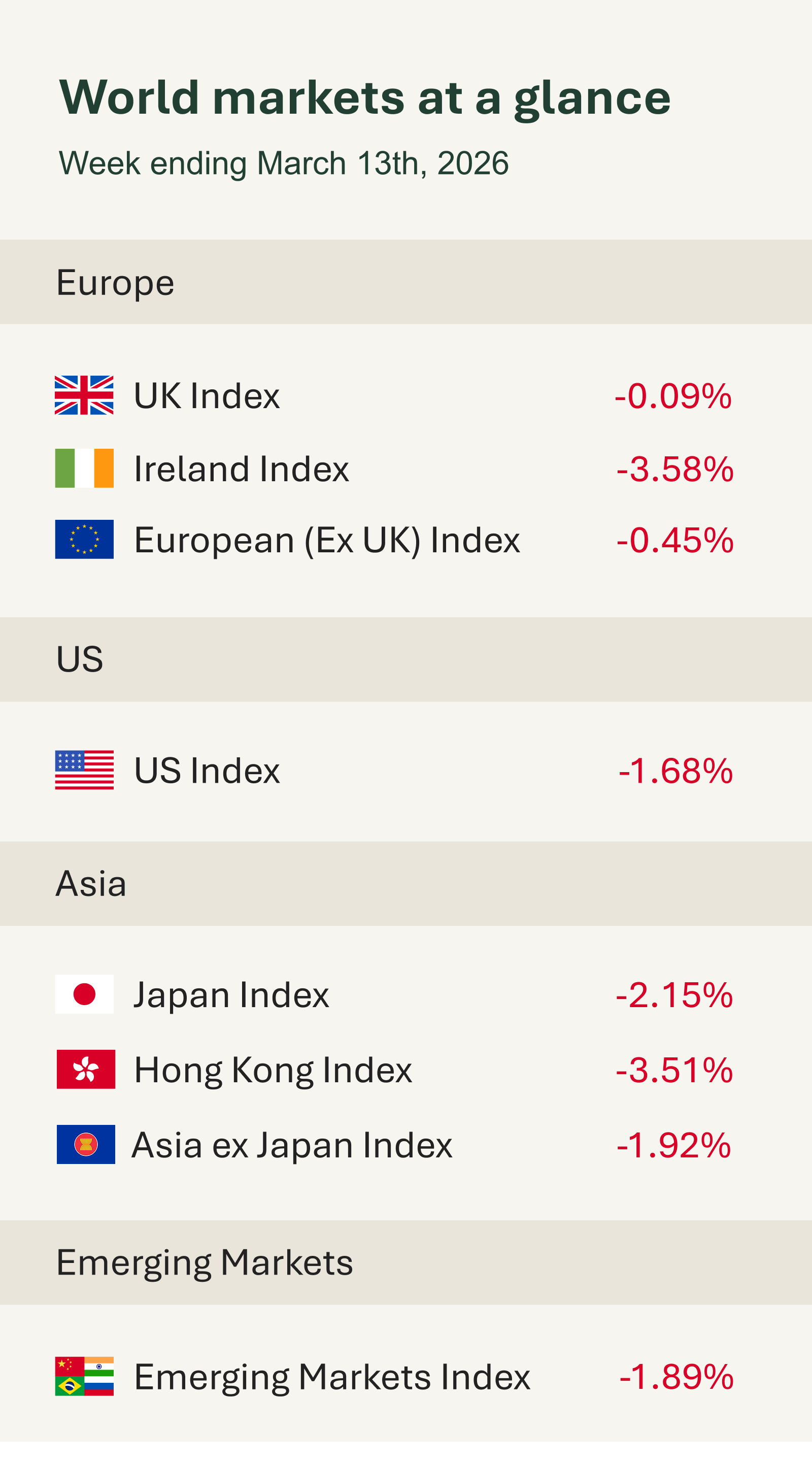
As you can see from the accompanying table, global markets closed the week lower.
It was another volatile week across the board as investors reacted to headlines dominated by the ongoing conflict in the Middle East and the subsequent dramatic swings in oil prices which touched $120 per barrel on Monday before falling rapidly sub $90 and finishing the week nearer $100.
Despite a sluggish economic growth report, the FTSE 100 held up better than other markets over the past week, supported by strong gains in energy majors like Shell and BP benefiting from sharply higher oil and gas prices amid the Iran conflict and by the index’s defensive, globally diversified composition.
Although conflict in the region has escalated, the U.S. introduced ambiguity by suggesting the war is “nearly over,” a statement at odds with conditions on the ground, leaving markets highly reactive to headlines and swinging sharply from gains to losses day‑to‑day.
Periods like this can feel deeply unsettling. The human tragedy reported in the news adds emotional weight, and the constant stream of conflicting information can tempt investors into acting hastily. However, history shows that making rapid decisions during volatile episodes often leads to poor outcomes. Maintaining a long‑term, level‑headed perspective remains crucial.
Importantly, our portfolios are designed to withstand short‑term noise. Their high level of diversification helps reduce the sharp swings often seen elsewhere in markets, allowing investors to remain focused on long‑term objectives rather than temporary market turbulence. Our investment management team remains level-headed, monitoring markets and ready to take up opportunities that arise.
On Wednesday, the International Energy Agency agreed to release 400 million barrels of oil to help offset supply disruptions caused by the Iran war. Even so, markets questioned whether this would be sufficient to counter the broader global supply shock. The G7 also signalled support for proactive measures, including the deployment of strategic reserves, though details remain limited. On Friday, the U.S. confirmed it would temporarily lift sanctions on Russian oil until 11th April; an action aimed at easing pressure on global oil prices without materially benefiting the Russian government. The update helped lift markets, with the FTSE 100, Euro Stoxx, and S&P 500 all eking out marginal gains.
Outside of oil prices and the Middle East. Attention was also on U.S. inflation data, with the latest CPI release landing just as higher energy prices push inflation expectations upward. Energy accounts for only around 6% of the CPI basket, meaning significant pressure on headline inflation typically arises