

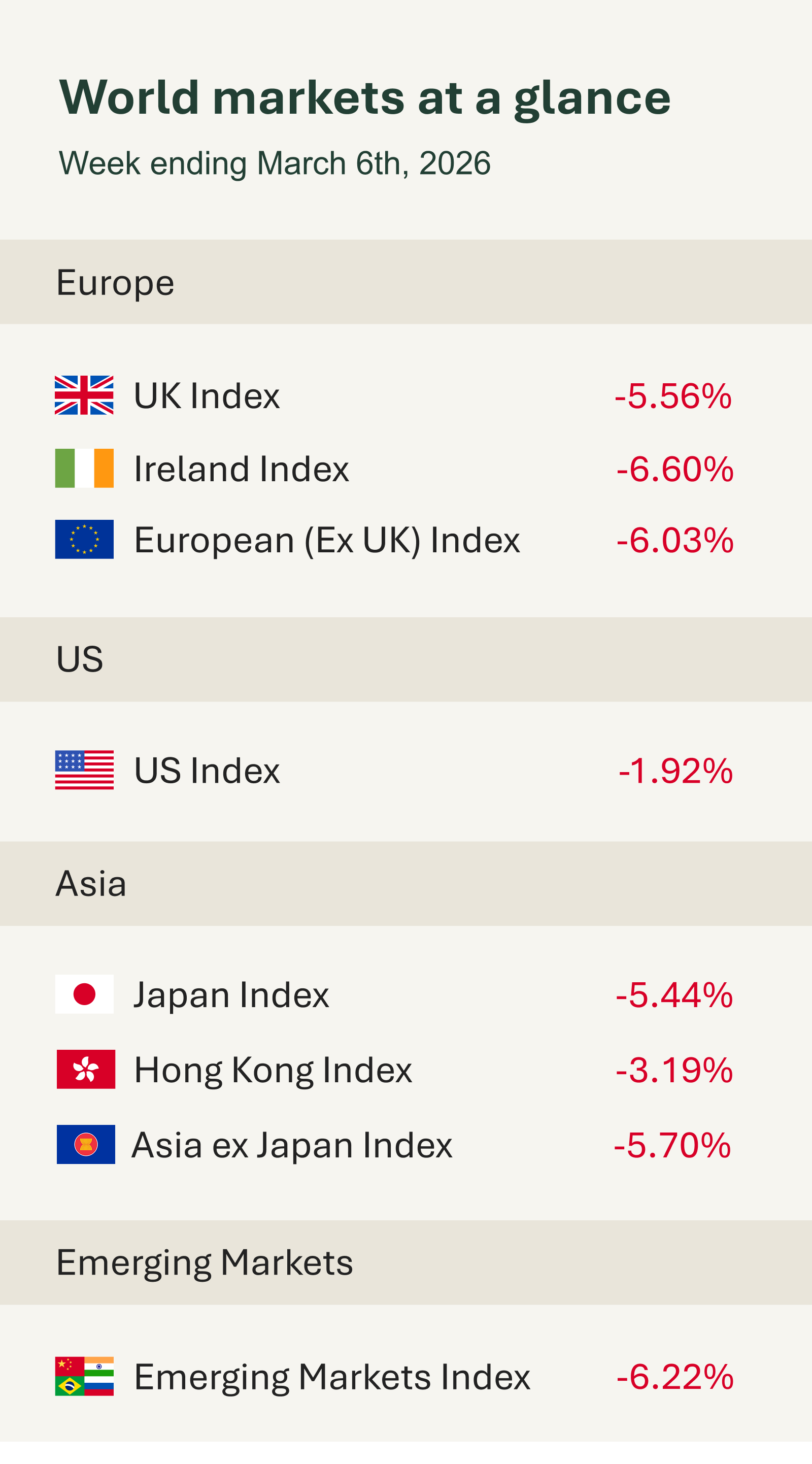
As you can see from the accompanying table, global financial markets closed the week significantly lower as sentiment was weighed down by the escalation of conflict in the Middle East. Markets indulged in a “seesaw” pattern of trading early on in the week as traders reacted to headlines, with brief relief rallies sparked by any signals of potential de-escalation or a reduction in supply chain disruptions.
Markets in South Korea and Japan were hit hardest early in the week due to heavy reliance on energy imports. Looking to the UK and Europe. The Eurozone bared the brunt of the sell-off due to its geographic proximity and energy sensitivities. The FTSE 100 fared slightly better due to its weighting in oil majors and defense names.
While the S&P 500 and Dow have also fallen, they have been slightly more resilient than international peers, partly due to the US being a major oil producer.
The week’s primary focus remained global energy markets and the Strait of Hormuz, where commercial tanker traffic has fallen by roughly 90% following recent hostilities. The heightened uncertainty initially pushed oil prices up about 12% at last week’s peak, and upon the market’s reopening they climbed further in early trading this morning, prices breached $100 per barrel as fears of prolonged disruption to global energy supplies grew over the weekend.
President Trump stated on Tuesday that the U.S. Navy is prepared to escort tankers, if necessary, while the International Development Finance Corporation (DFC) has been directed to provide political risk insurance and financial guarantees to stabilize maritime trade. While ship owners remain cautious about the sufficiency of these measures, the intervention provided a psychological floor for the markets mid-week.
Concerns have grown that a prolonged conflict could reignite inflationary pressures through elevated energy costs. With the Strait of Hormuz effectively closed, the resulting ‘energy shock’ is expected to keep inflation elevated, complicating central banks’ efforts to cut interest rates as previously anticipated. However, given the ever-evolving situation markets are not yet treating current events as permanent. In the UK, the scheduled £150 reduction in domestic energy bills (on average) next month provides an important buffer for households facing persistent commodity‑driven pressures.
Whilst the headlines are dominated by Middle Eastern developments, our Investment Management team remains steadfast. Beyond the geopolitical noise, we continue to monitor the broader market landscape.