
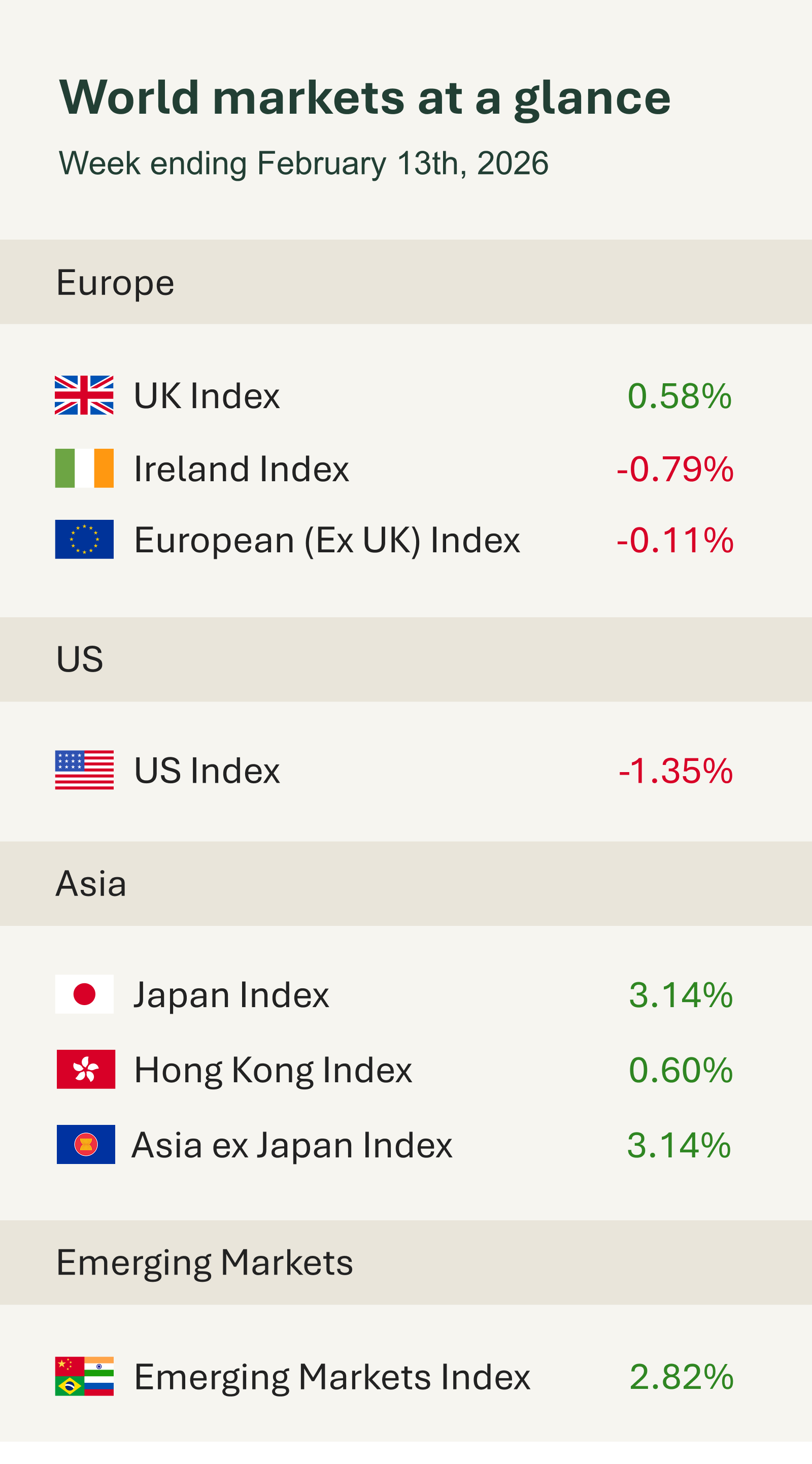
Week ending 13th February 2026.

There was a substantial amount of economic data for markets to absorb this week. Overall, global market performance was mixed: US equities declined amid concerns around the potential disruption caused by rapid advances in AI, while the UK, Europe, and markets across Asia and emerging economies fared comparatively better.

A delayed batch of U.S. labour market data was released mid-week, prompting only a muted reaction from equity markets.

The data showed that job growth accelerated in January, reinforcing signs of labour market stability. Nonfarm payrolls increased by 130,000, following a downwardly revised gain of 48,000 in December. Meanwhile, the unemployment rate declined from 4.4% to 4.3%. Overall, the figures suggest the labour market remains on solid footing. This resilience gives the Federal Reserve flexibility to keep interest rates unchanged in the near term while policymakers continue monitoring inflation trends.

On the inflation front, January’s Consumer Price Index (CPI) report indicated further moderation. Annual headline inflation slowed to 2.4%, down from 2.7% in each of the previous two months and below consensus forecasts. The deceleration was partly driven by base effects, as stronger readings from a year ago dropped out of the annual calculation, as well as a notable decline in energy prices.

Core inflation, which excludes food and energy, edged down to 2.5% from 2.6% in December, in line with expectations. It is important to note that this represents only one month of data. However, if the current trajectory continues, it will support a path toward lower interest rates alongside gradually easing inflation pressures.

Markets edged lower late in the week as investors assessed the rapid pace of advancement in artificial intelligence. Some near-term uncertainty is natural as markets adjust to transformative technologies, but the long-term outlook for AI remains compelling. While short term volatility is inevitable, our diversified approach helps to mitigate its impact. By spreading investments across sectors and regions, our portfolios are not overly reliant on any one area, allowing us to navigate periods of short-term noise/disruption while remaining positioned to capture long-term opportunities.

Despite heightened political noise this week, including calls for Prime Minister Keir Starmer to resign markets remained anchored in fundamentals. The UK market outperformed major global indices, with the FTSE 100 rising 0.74% over the week.

Fresh economic data released on Thursday provided a clearer picture of the UK’s recent performance. GDP grew by 0.1% in the final quarter of 2025 and 1.3% over the year. While these figures confirm that the economy continued to expand, they also point to relatively modest momentum. Quarterly growth was unchanged from the previous period and came in slightly below expectations.

A more detailed breakdown showed that the services sector, which has been a key driver of the UK economy, recorded zero growth. Even so, there were pockets of resilience within the sector, especially within travel agencies and tour operators.

China’s property market showed early signs of stabilisation in January, with the decline in resale home prices easing to the smallest drop in eight months, while new home prices fell at a steady pace.

The People’s Bank of China reiterated its “moderately loose” policy stance for 2026, signalling potential for further rate and reserve requirement cuts, and injected liquidity ahead of the Lunar New Year to support market conditions.

Next week, mainland China and Hong Kong markets will be closed for Lunar New Year, making for a quieter global calendar. In the US, markets close on Monday for Presidents’ Day, with housing data and Fed meeting minutes due later in the week. In the UK, key releases include unemployment, retail sales, inflation, and PMI data.

Kate Mimnagh, Portfolio Economist

The latest market updates are brought to you by Investment Managers & Analysts at Wealth at Work Limited which is a member of the Wealth at Work group of companies.

Links to websites external to those of Wealth at Work Limited (also referred to here as 'we', 'us', 'our' 'ours') will usually contain some content that is not written by us and over which we have no authority and which we do not endorse. Any hyperlinks or references to third party websites are provided for your convenience only. Therefore please be aware that we do not accept responsibility for the content of any third party site(s) except content that is specifically attributed to us or our employees and where we are the authors of such content. Further, we accept no responsibility for any malicious codes (or their consequences) of external sites. Nor do we endorse any organisation or publication to which we link and make no representations about them.