
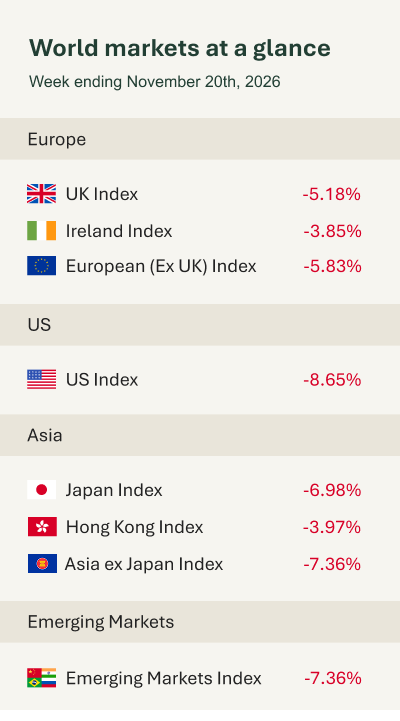
week ending 20th November 2026.

As you can see from the accompanying table, global financial markets came under pressure this week as investors grappled with concerns over AI valuations and interest rates. While technology stocks bore the brunt of the sell-off, declines broadened across markets. Nevertheless, underlying corporate earnings and economic data continue to provide some reassurance.

In the U.S., the S&P 500 and technology-heavy Nasdaq fell sharply over the week. All 11 sectors of the S&P 500 recorded losses, although more defensive areas, including consumer staples and utilities, proved relatively resilient. Much of the uncertainty has centred on artificial intelligence (AI), with investors questioning whether the substantial investment in the technology will generate sufficient returns to justify current valuations.

Despite this, demand for AI remains incredibly strong. Nvidia reported another exceptional set of quarterly results this week, with revenues reaching $115.8 billion, more than double those recorded a year earlier. Nevertheless, its shares came under pressure as uncertainty surrounding leadership overshadowed the strength of its financial performance.

Meanwhile, Anthropic, the AI company behind Claude, made history on Thursday, initially raising $81 billion in the largest initial public offering (IPO) ever recorded. Shares finished their first day of trading 17% above their issue price before surrendering much of those gains on Friday. Whilst volatility is not unusual for newly listed companies, its debut highlighted that investor demand is there and investors are not questioning the long-term potential of AI, but rather how much they are prepared to pay for its future growth.

Given the contribution of AI-related investment to U.S. economic growth, concerns have also extended to the wider market, including European and Asian equities. However, this comes against a backdrop of generally resilient corporate earnings, suggesting that recent share price movements do not necessarily reflect an equivalent deterioration in underlying business fundamentals.

Earlier in the week, the minutes from the Federal Reserve’s October meeting, at which policymakers held interest rates at 3.75%–4.00%, revealed that almost all officials anticipated further interest rate increases, with some describing October’s decision to hold as a close call.

Policymakers highlighted that elevated energy prices continue to contribute to inflationary pressures, while growing demand associated with the expansion of AI infrastructure is placing pressure on supply chains and increasing the cost of technology-related consumer goods. Nevertheless, longer-term inflation expectations remain consistent with the Federal Reserve’s 2% objective, whilst economic activity continues to expand at a strong pace and labour market conditions remain stable.

There has been some welcome relief on the inflationary front, with Brent crude oil declining for a third consecutive week to around $93 per barrel as supply increased. A sustained moderation in energy prices would provide welcome relief for households and businesses, whilst potentially alleviating some of the inflationary pressures facing central banks.

In the UK, the FTSE 100 ended the week lower. However, economic data showed resilience, with retail sales volumes rising 0.7% in October, ahead of expectations and recovering from September’s decline. While spending was partly driven by households stocking up on essentials, the figures provided a more encouraging picture of consumer activity.

Whilst recent market declines are understandably unsettling, reasons remain for investors to maintain perspective. 84% of S&P 500 companies reporting third-quarter results exceeded earnings expectations, demonstrating continued resilience in corporate profitability.

History also provides some perspective, with the strongest and weakest trading days often occurring in close succession. Timing the market is notoriously difficult, and reacting to short-term volatility risks realising losses and missing out on subsequent recoveries.

Our portfolios are diversified across asset classes, regions and sectors, helping to cushion the effects of short-term market movements. While volatility may persist, this highlights the importance of disciplined asset allocation and maintaining a long-term perspective.

Sentiment has improved at the start of the week, with US futures trading sharply higher and both UK and European markets opening stronger.

Coming up next week preliminary manufacturing and services activity figures from the major economies, alongside revised U.S. economic growth figures and the Federal Reserve’s preferred measure of inflation, the PCE price index. It will also be a holiday-shortened week in the U.S. due to Thanksgiving, with Black Friday providing an early indication of consumer spending ahead of the festive period.

Kate Mimnagh, Portfolio Economist

The latest market updates are brought to you by Investment Managers & Analysts at Wealth at Work Limited which is a member of the Wealth at Work group of companies.

Links to websites external to those of Wealth at Work Limited (also referred to here as 'we', 'us', 'our' 'ours') will usually contain some content that is not written by us and over which we have no authority and which we do not endorse. Any hyperlinks or references to third party websites are provided for your convenience only. Therefore please be aware that we do not accept responsibility for the content of any third party site(s) except content that is specifically attributed to us or our employees and where we are the authors of such content. Further, we accept no responsibility for any malicious codes (or their consequences) of external sites. Nor do we endorse any organisation or publication to which we link and make no representations about them.