
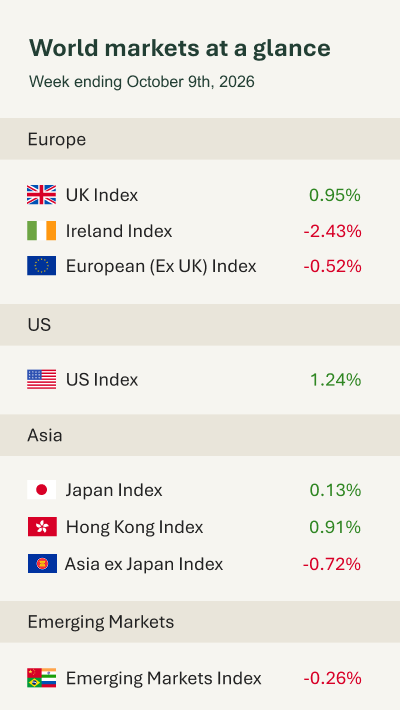
Week ending 9th October 2026.

As you can see from the accompanying table, global equity markets delivered mixed returns last week, amid further volatility in oil prices, government bonds and technology shares. The US index gained 1.24%, while UK equities rose 0.95%, outperforming both broader European markets and Irish equities. Performance across Asia was mixed. Mainland Chinese shares declined in a holiday-shortened week following Golden Week, while Hong Kong equities advanced and Japanese stocks edged higher.

Markets got off to a positive start, helped by gains in technology shares, although higher borrowing costs remained a concern. US 10- and 30-year Treasury yields reached their highest levels since 2002 as investors weighed persistent inflation, government borrowing and the possibility of further interest rate increases. Bond yields, did retreat from their peaks as Treasury auctions attracted strong demand. Investment-grade corporate bonds also continued to draw buyers. While rising yields have put pressure on existing bond prices, they have improved the income available to investors, providing a stronger starting point for longer-term fixed income returns.
Wednesday’s minutes from the Federal Reserve’s September meeting where policymakers voted to raise interest rates by 0.25% revealed the decision was unanimous with most officials expecting another before year-end. They gave little indication that a move was necessary in October, however, leaving the Fed room to assess incoming data. Meanwhile, the US services sector continued to expand in September, although its survey of prices paid pointed to persistent inflationary pressure.
By Thursday, attention had turned to the Middle East. Brent crude briefly exceeded $105 a barrel after fresh attacks on tankers near the Strait of Hormuz, reversing an earlier fall following news of an accelerated release of oil reserves. The prospect of sustained high energy costs revived inflation concerns and weighed on global equities, particularly in Asia.

Artificial-intelligence-related shares also came under pressure after reports suggested OpenAI’s annualised revenue was roughly $20 billion below some previous estimates, prompting questions about valuations and the scale of AI investment. Shares in several listed technology companies fell but rebounded on Friday as it became clearer that differences in how revenue was reported accounted for much of the discrepancy.

Friday also brought some relief for markets after President Trump said the US would not attack Iran ahead of the mid-term elections which take place on the 3rd of November, with oil prices retreating and bond yields moving lower in response. Oil dipped initially but rebounded as a hurricane disrupted production in the US Gulf of Mexico, leaving Brent around $104.72 at the close and higher over the week.

Elsewhere on Friday, China and the European Union reached a preliminary trade agreement that could reduce Chinese hybrid and plug-in hybrid vehicle exports to Europe by more than half over the next four years. The announcement helped lift European carmakers’ shares and marked a step towards easing trade tensions between the two economies, although details of how the agreement will be implemented remain to be finalised.
Over the weekend, Trump also announced an agreement with Russia to supply more than 300,000 tonnes of diesel to US and global markets, with a temporary easing of US sanctions. Prices initially fell, but questions remain on whether the volumes would materially ease supply shortages. Trump also claimed a Russia–Ukraine energy ceasefire, although this remained unconfirmed by Ukraine and Russia.

Looking ahead, Updated IMF growth forecasts will also be published. US earnings season gets underway with JPMorgan, Citigroup, Goldman Sachs and Wells Fargo reporting on Tuesday, followed by Bank of America and Morgan Stanley on Wednesday.

Wednesday also brings US consumer inflation figures and the Federal Reserve’s Beige Book, followed on Thursday by producer prices, retail sales and the UK’s August GDP figures. TSMC also reports and will be a key read-through for the AI chip complex, providing insight into demand trends, and the broader outlook for AI-related semiconductor spending.

Kate Mimnagh, Portfolio Economist

The latest market updates are brought to you by Investment Managers & Analysts at Wealth at Work Limited which is a member of the Wealth at Work group of companies.

Links to websites external to those of Wealth at Work Limited (also referred to here as 'we', 'us', 'our' 'ours') will usually contain some content that is not written by us and over which we have no authority and which we do not endorse. Any hyperlinks or references to third party websites are provided for your convenience only. Therefore please be aware that we do not accept responsibility for the content of any third party site(s) except content that is specifically attributed to us or our employees and where we are the authors of such content. Further, we accept no responsibility for any malicious codes (or their consequences) of external sites. Nor do we endorse any organisation or publication to which we link and make no representations about them.