

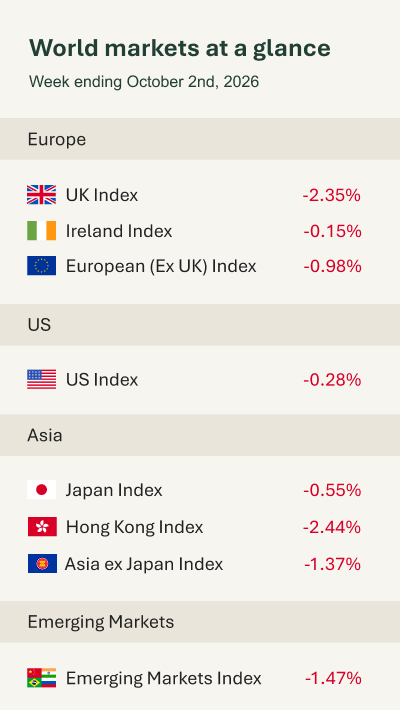
As you can see from the accompanying table, global financial markets were generally softer this week, as investors digested a further rise in government bond yields alongside economic data, corporate earnings and continued geopolitical uncertainty.
Much of the attention has been on bond markets. The US 10-year Treasury yield briefly reached 5.34% on Thursday, its highest level since 2002, while the 30-year yield moved towards 5.7%. In the UK, the 30-year gilt yield moved above 6% for the first time since 1998, with longer-term borrowing costs also rising across Europe and Japan.
So, why have yields risen?
There is no single trigger. Economic growth has remained relatively resilient; inflation is still above central-bank targets and higher energy prices have added uncertainty around the outlook for inflation and interest rates. Countries with higher debt burdens, such as Japan, have generally seen larger increases in bond yields, as investors demand greater compensation for lending to governments and absorbing substantial new debt issuance.
Higher yields do not, in themselves, mean there is a problem with government bond markets. Rather, markets are reassessing where interest rates, inflation and government borrowing may settle. Higher yields also increase the cost of new government borrowing and refinancing and can feed through into borrowing costs elsewhere in the economy, including mortgages and corporate finance.
For investors, however, bond yields are now among their most attractive levels in years, providing a much stronger source of income than has been available for much of the past decade. Our strategy of holding a diversified spread of financially secure companies with investment-grade credit ratings and stable income until they mature means that this price weakness, while understandably unsettling, shouldn’t be too concerning as maturity dates and values are known.