
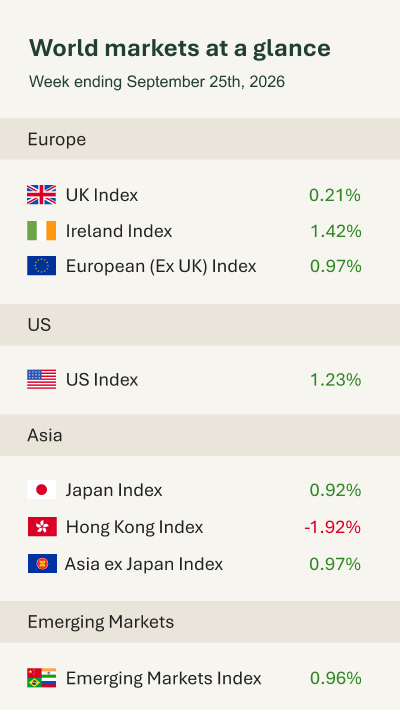
Week ending 25th September 2026

Much of the focus this week remained on geopolitics. Oil prices see-sawed throughout the week, while government bond yields moved higher across the UK, U.S. and Europe as stronger-than-expected economic data added to expectations that central banks may need to raise interest rates further.

Despite some sizeable moves beneath the surface, equity markets were relatively positive, with weekly moves modest given the volatility across oil and bond markets.

Oil prices began the week below $100 per barrel, having fallen by around 9% amid signs of potential de-escalation in the Middle East. However, prices moved back above $100 during the middle of the week as uncertainty surrounding the conflict and global energy supply remained elevated.

Meanwhile, U.S. 10-year Treasury yields climbed above 5%, reaching their highest level since 2007, as stronger economic data reinforced expectations that the Federal Reserve may need to raise interest rates again.

One of the main catalysts was the latest Purchasing Managers’ Index, or PMI, data. The PMI is a closely watched indicator of economic activity, with a reading above 50 signalling expansion and a reading below 50 indicating contraction.

The U.S. Composite PMI rose to 58.4 in September, marking the strongest expansion in business activity since July 2021. Growth was led by the services sector, while the Manufacturing PMI increased to 57.0 from 53.9 in August. The data suggest the U.S. economy continues to expand at a healthy pace but also pointed to rising cost pressures. This combination of resilient growth and persistent inflation strengthened expectations that the Federal Reserve could tighten monetary policy further.

Closer to home, the Eurozone Composite PMI rose to 53.1 in September from 52.0 in August, comfortably ahead of expectations and marking the fastest rate of expansion in more than three years.

Growth accelerated across both manufacturing and services, with Germany recording its strongest expansion in almost a year and activity in France also improving. However, businesses continued to report rising input costs, particularly as higher energy prices fed through to the wider economy.

The picture in the UK was more subdued. Business activity remained in expansion territory, but growth slowed, with the Services PMI falling to 51.7 from 52.5 in August. At the same time, businesses reported increasing inflationary pressures, leaving the Bank of England facing a difficult balance between relatively modest growth and renewed upward pressure on prices.

Geopolitics also remained in focus as Chinese President Xi Jinping travelled to Washington for talks with U.S. President Donald Trump. The summit was heavy on symbolism and personal diplomacy, but some tangible agreements emerged. The U.S. and China agreed to extend their trade truce by a further two months, announced tariff reductions covering around $30 billion of non-sensitive goods (in each direction) and established a new bilateral trade council.

Artificial intelligence was also discussed, with both sides agreeing to establish a formal dialogue on AI safety. However, there was little evidence of a broader breakthrough on more difficult issues, including Taiwan, technology restrictions and the longer-term trading relationship. The meeting therefore appeared to stabilise relations rather than fundamentally reset them.

Overall, the week highlighted the competing forces currently driving markets. Economic activity remains relatively resilient, particularly in the U.S. and Europe, but stronger growth is occurring alongside higher energy prices and renewed inflationary pressures. Looking ahead to next week, attention will focus on the US ISM Manufacturing Index, Eurozone inflation data, and key U.S. labour market releases later in the week, including the unemployment rate and non-farm payrolls. In the UK, the Labour Party conference runs from Sunday to Wednesday, with markets watching for any policy signals ahead of the Autumn Budget, where detailed policy measures are expected to be unveiled.

Kate Mimnagh, Portfolio Economist

The latest market updates are brought to you by Investment Managers & Analysts at Wealth at Work Limited which is a member of the Wealth at Work group of companies.

Links to websites external to those of Wealth at Work Limited (also referred to here as 'we', 'us', 'our' 'ours') will usually contain some content that is not written by us and over which we have no authority and which we do not endorse. Any hyperlinks or references to third party websites are provided for your convenience only. Therefore please be aware that we do not accept responsibility for the content of any third party site(s) except content that is specifically attributed to us or our employees and where we are the authors of such content. Further, we accept no responsibility for any malicious codes (or their consequences) of external sites. Nor do we endorse any organisation or publication to which we link and make no representations about them.