
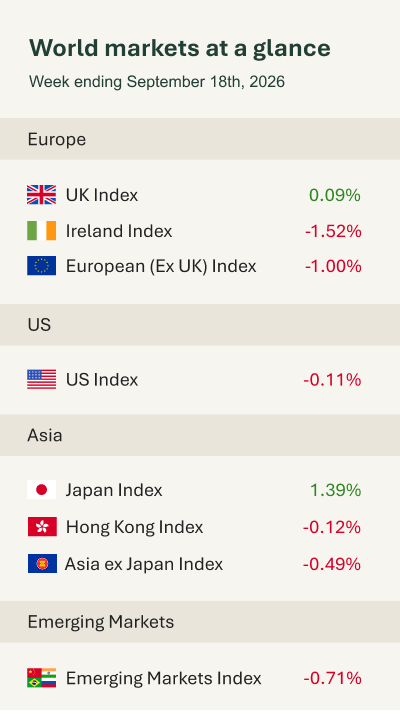
Week ending 18th September 2026.

As shown in the accompanying table, it was a mixed week for global financial markets. Japan led gains, while the UK delivered a modest positive return. Most other regions declined, while the US was broadly flat.

It was a busy week for central banks, with policymakers in the US, UK and Japan all announcing interest-rate decisions. While the outcomes were broadly in line with market expectations, the backdrop of persistent inflation, higher energy prices and geopolitical uncertainty continued to weigh on sentiment, leaving global equity performance uneven.

In the US, the Federal Reserve raised interest rates by 0.25% on Wednesday, taking the federal funds target range to 3.75%–4.00%. This marked the Fed’s first-rate increase in more than three years and was unanimously supported by policymakers. Chair Kevin Warsh stressed that inflation remained too high and had done so for too long, with the Fed seeking to bring inflation back towards its 2% target.

The decision highlights the difficult balancing act facing policymakers. Much of the recent inflationary pressure has been linked to higher energy prices, which conventional monetary policy has limited ability to directly address. The Fed’s move followed the European Central Bank’s decision earlier in the month to raise rates for the second time this year. Nevertheless, the US economy has remained relatively resilient. August retail sales rose by a stronger-than-expected 1.2%, demonstrating continued consumer demand despite higher fuel prices and broader cost pressures.

US equity markets were initially supported by stronger-than-expected retail sales data but lost momentum following the Federal Reserve’s announcement. Meanwhile, bond yields eased from their recent highs, helping to reinforce investor confidence in the Fed’s commitment to controlling inflation. The dot plot, which reflects individual policymakers’ expectations for the future path of short-term interest rates, indicated that most Fed officials expect at least one further rate hike before year-end.

Closer to home, the Bank of England bucked the recent trend for higher rates and left Bank Rate unchanged at 3.75% for a sixth consecutive meeting. The Monetary Policy Committee voted 6–3 in favour of keeping rates steady, with three members preferring a 0.25% hike to 4%.

The decision came despite UK inflation rising to 3.1% in August, with the Bank warning that higher oil, gas and refined-energy prices could push inflation further above target over the coming quarters. However, policymakers also noted that there has so far been limited evidence of significant second-round effects feeding into wider wages and prices, while softer labour-market conditions should help moderate domestic inflationary pressure.

Importantly, the UK economy has proved more resilient than the Bank previously expected. However, policymakers remain cautious, with inflation projected to rise towards 4% around year-end if energy prices remain elevated. As a result, while the MPC can afford to pause and assess incoming data, further rate increases cannot be ruled out if inflationary pressures prove more persistent.

UK consumers defied market expectations as retail sales volumes rose by 0.5% month on month in August 2026 rather than a fall and rebounding from a decline in July. Despite headwinds facing consumers, most categories of spending rose, led by department stores, clothing and footwear and household goods.

On Friday, the Bank of Japan raised its policy rate by 0.25% to 1.25%, the highest level in 31 years. The move was again broadly anticipated as policymakers continue the gradual normalisation of monetary policy following decades of exceptionally low interest rates. Inflation has moved closer to the Bank’s 2% target, while weakness in the yen and elevated fuel prices continue to present upside risks. Despite the rate increase, the yen weakened following the announcement as investors questioned the speed of further tightening.

Coming up next week, PMI data from across the UK, Europe and US. Meta Platforms, will hold its two-day Connect event beginning Wednesday 23rd September, with updates expected on AI, AI-powered glasses and virtual and mixed reality. On Thursday 24th September, President Trump will meet with China’s President Xi at the White House. Key topics are expected to include Taiwan, AI, tariffs, global conflicts. UK consumer confidence and US durable goods orders are due at the end of the week.

Kate Mimnagh, Portfolio Economist

The latest market updates are brought to you by Investment Managers & Analysts at Wealth at Work Limited which is a member of the Wealth at Work group of companies.

Links to websites external to those of Wealth at Work Limited (also referred to here as 'we', 'us', 'our' 'ours') will usually contain some content that is not written by us and over which we have no authority and which we do not endorse. Any hyperlinks or references to third party websites are provided for your convenience only. Therefore please be aware that we do not accept responsibility for the content of any third party site(s) except content that is specifically attributed to us or our employees and where we are the authors of such content. Further, we accept no responsibility for any malicious codes (or their consequences) of external sites. Nor do we endorse any organisation or publication to which we link and make no representations about them.