

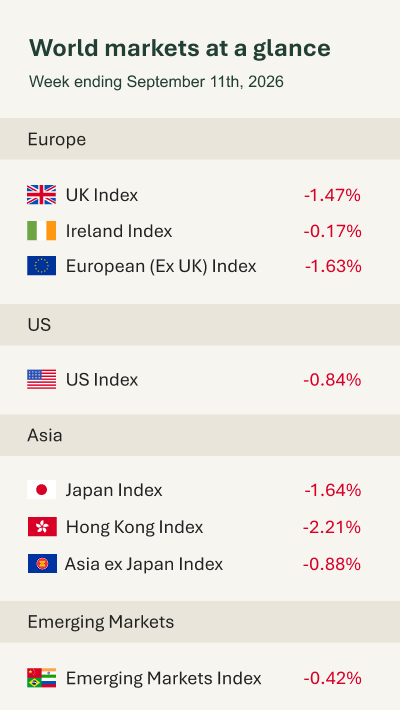
As you can see from the accompanying table, global equity markets were generally lower over the week, with geopolitical developments, rising energy prices, and changing expectations for interest rates weighing on sentiment.
Geopolitics remained the main driver of markets. Brent crude rose above $100 a barrel, briefly nearing $110 as tensions between the U.S. and Iran escalated and Iran-aligned Houthi forces seized Yemen’s port of Mocha. Concerns over disruption to Red Sea shipping and continued restrictions in the Strait of Hormuz pushed prices higher. Brent settled at around $104.50 on Friday, below its intraweek peak but still sharply higher on the week.
The rise in energy prices added to concerns that inflation could remain elevated for longer, prompting investors to increase expectations for further interest rate rises. This was reflected across global bond markets, where government bond prices fell and yields moved higher. In the UK, the yield on the benchmark 10-year gilt rose to around 5.4%, its highest level since 2007. Similar moves were seen in the U.S., where the yield on the benchmark 10-year Treasury briefly approached 5%, highlighting the sensitivity of bond markets to changing expectations for inflation and monetary policy.
Against this backdrop, the European Central Bank raised its three key interest rates by 0.25% on Thursday, taking the deposit rate to 2.50%. The ECB acknowledged that higher energy costs continue to add to inflationary pressures and revised its inflation forecasts higher for both 2027 and 2028. Policymakers also noted that inflation could prove stickier than previously anticipated, reinforcing expectations that monetary policy may need to remain restrictive for longer. However, there was also some encouragement in the economic outlook, with growth forecasts for 2026 and 2027 upgraded following greater-than-expected resilience across the euro area. Policymakers stressed that uncertainty remains elevated, with risks tilted towards higher inflation and weaker growth depending on how the energy shock develops. As the rate increase was largely priced in by markets, the immediate reaction was relatively muted.