
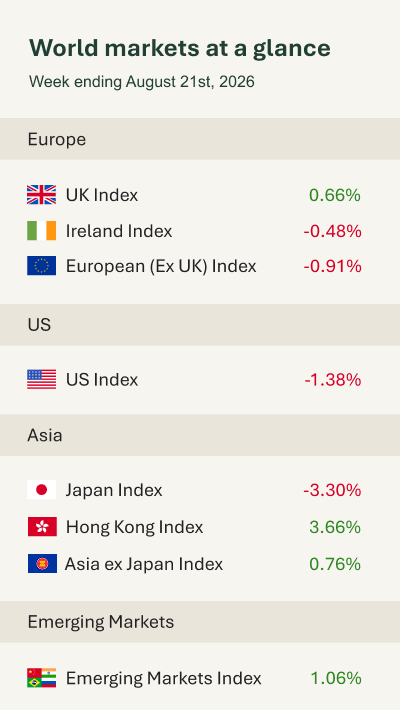
Week ending 21st August 2026.

Global financial markets closed the week on a mixed note, with investor attention focused on inflation data from the UK and eurozone, alongside the minutes from the Federal Reserve’s July meeting. Rising bond yields initially weighed on equity markets, particularly technology and semiconductor stocks, as investors reconsidered the outlook for interest rates. Tensions between the US and Iran and higher oil prices added to caution. However, easing bond yields later in the week helped improve sentiment, with Asian equities rebounding from recent weakness.

The dominant theme this week was the sell-off in global bond markets, with long-term government bond yields rising to levels not seen since before the global financial crisis. As bond prices and yields move inversely, higher yields increase borrowing costs across the economy, making it more expensive for governments, businesses and households to borrow, which can weigh on growth and financial markets.

The rise in yields reflects investors demanding greater compensation amid concerns over growing fiscal deficits, persistent inflation risks and higher oil prices. While this has created market volatility, it is not a sign of financial system stress. Sentiment improved after the US Treasury announced plans to increase purchases of longer-dated government debt, helping ease liquidity concerns and showing policymakers have tools to support market functioning if borrowing costs rise too quickly. Government bond markets remain deep and liquid, and higher yields may ultimately attract investors back by offering more attractive returns.

The minutes of the July Federal Open Market Committee meeting highlighted policymakers’ continued concern around upside risks to inflation. While participants generally expected inflation to moderate over the remainder of the year, they acknowledged that the outlook was highly uncertain and that inflation risks were skewed to the upside. Some officials indicated that further tightening could be warranted if inflation failed to decline.

However, the latest economic data remains relatively resilient, with US business activity accelerating sharply in August. Composite PMI rose to 56.0, its highest level since April 2022, driven by a strong services sector. We therefore expect incoming inflation and labour-market data to remain critical to the Federal Reserve’s decision-making, with the resilience of the economy giving policymakers scope to remain patient for now.

European stocks closed the week lower, although the UK’s FTSE 100 outperformed. The index was supported by stronger UK private sector activity in August and a surge in gold prices, which boosted mining stocks. The UK PMI Composite Output Index rose to 52.5 from 52.2 in July, remaining above the 50 threshold that separates expansion from contraction for a second consecutive month. Meanwhile, the Services PMI Business Activity Index edged up to a six-month high of 52.8. Business activity was reportedly supported by sunny weather and continued investment in technology, despite ongoing concerns surrounding Middle East tensions and domestic government policy.

In Europe, the eurozone economy showed some signs of improving momentum, however, the data failed to offset broader concerns surround on the Middle East and rising bond yields. August composite PMI rose to 52.1 from 52.0 in July, with new orders increasing and export demand returning to growth for the first time in four and a half years. Germany also provided some encouragement, with manufacturing activity strengthening and investor confidence improving. However, services activity remains weak, highlighting that the recovery is not yet broad-based.

Looking ahead, markets will focus on the Fed’s preferred inflation measure, the PCE price index, alongside US durable goods orders and second-quarter GDP. In Europe, eurozone economic sentiment. Nvidia, the world’s leading AI chipmaker, reports earnings on Wednesday. The results will be closely watched as an indicator of the durability of the AI investment theme. Later in the week, attention will shift to the Jackson Hole Symposium, where investors will look to Fed Chair Kevin Warsh for clues on the outlook for monetary policy, inflation and potential rate cuts.

Kate Mimnagh, Portfolio Economist

The latest market updates are brought to you by Investment Managers & Analysts at Wealth at Work Limited which is a member of the Wealth at Work group of companies.

Links to websites external to those of Wealth at Work Limited (also referred to here as 'we', 'us', 'our' 'ours') will usually contain some content that is not written by us and over which we have no authority and which we do not endorse. Any hyperlinks or references to third party websites are provided for your convenience only. Therefore please be aware that we do not accept responsibility for the content of any third party site(s) except content that is specifically attributed to us or our employees and where we are the authors of such content. Further, we accept no responsibility for any malicious codes (or their consequences) of external sites. Nor do we endorse any organisation or publication to which we link and make no representations about them.