
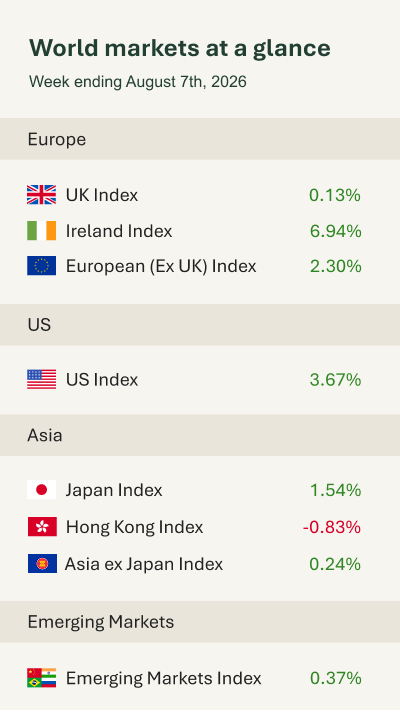
Week ending 7th August 2026.

As can be seen from the accompanying table, markets broadly ended the week higher.

Reports indicated that China’s trade surplus widened to $112.5bn in July, slightly below June’s level but still ahead of market expectations. Exports in U.S. dollar terms grew more strongly than forecast, supported by robust global demand for AI infrastructure and related Chinese-manufactured goods. In particular, exports of high-tech products, including electric vehicles, lithium batteries, and wind power equipment, rose by nearly 41%. Analysts expect China’s export sector to remain resilient through the third quarter. However, the country’s large trade surpluses with major economies such as the United States and Europe continue to fuel trade tensions and increase pressure on Beijing to address trade imbalances. China has rejected concerns over industrial overcapacity, with the Commerce Ministry arguing in a recent position paper that such claims are unfounded and are being used to justify protectionist measures against Chinese exports.

Over in Japan, household spending unexpectedly fell by 3.3% year-on-year in June, marking a seventh consecutive month of subdued consumer spending. While the cost of living continues to weigh on households, analysts suggest the weakness reflects broader caution among consumers rather than inflation alone. The figures come as markets increasingly debate whether the Bank of Japan will deliver another interest rate hike in September. Although this latest release is likely to give policymakers pause by raising questions over the strength of domestic demand, it is only one data point. With other indicators over the course of this year suggesting consumption improved during the second quarter, the Bank of Japan may wait for further evidence before making any policy decisions.

U.S. labour market data released on Friday showed that employment weakened more than expected, with employers shedding 23,000 jobs in July.

The unemployment rate remained unchanged at 4.1%, while wage growth also moderated, with average hourly earnings rising 3.2% year-on-year. This suggests that, while hiring is weakening, layoffs remain relatively low, leaving the labour market in a “low-hire, low-fire” environment. The softer labour market data is likely to reduce pressure on policymakers to keep interest rates higher for longer and could strengthen the case for rate cuts if the slowdown continues. However, inflation remains the crucial piece of the puzzle. Next week’s inflation data will provide a clearer indication of whether price pressures are continuing to ease or proving more persistent.

Meanwhile, oil prices ebbed and flowed following developments surrounding the Strait of Hormuz. Initial optimism that diplomatic efforts involving Iran and Oman could help restore shipping through the route provided some relief, pushing prices lower. However, that optimism faded as uncertainty grew over the conditions being placed on vessels using the strait, alongside reports of further attacks in the region. Brent crude consequently climbed back above $83 a barrel by Friday. Despite the renewed volatility, it is worth noting that prices remain well below the peaks reached earlier in the conflict, settling back within its recent trading range. This suggests that markets are not yet pricing in a return to the most severe supply disruption seen during the war and the geopolitical risk premium – at least for the time being – has faded.

Still to come this week we have Japan’s PPI data, UK GDP and U.S. retail sales.

Nicola Tune, Portfolio Specialist

The latest market updates are brought to you by Investment Managers & Analysts at Wealth at Work Limited which is a member of the Wealth at Work group of companies.

Links to websites external to those of Wealth at Work Limited (also referred to here as 'we', 'us', 'our' 'ours') will usually contain some content that is not written by us and over which we have no authority and which we do not endorse. Any hyperlinks or references to third party websites are provided for your convenience only. Therefore please be aware that we do not accept responsibility for the content of any third party site(s) except content that is specifically attributed to us or our employees and where we are the authors of such content. Further, we accept no responsibility for any malicious codes (or their consequences) of external sites. Nor do we endorse any organisation or publication to which we link and make no representations about them.