
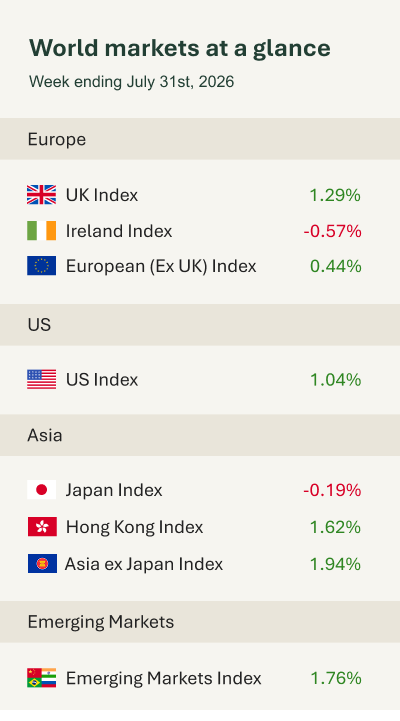
Week ending 31st July 2026.

As you can see from the accompanying table it was broadly a positive week for global financial markets. While markets finished the week relatively steady, sentiment shifted repeatedly as investors assessed the outlook for inflation, interest rates and the sustainability of artificial intelligence (AI)-driven earnings growth.

Mid-week, as expected, the US Federal Reserve left interest rates unchanged at 3.50%–3.75%. however, the decision was not unanimous, with policymakers voting 9-3 in favour of holding rates, highlighting growing concern within the committee that inflationary pressures remain persistent.

Federal Reserve Chair Kevin Warsh reiterated that the central bank “will not waver” in its commitment to returning inflation to its 2% target. While avoiding explicit commentary on future policy, he acknowledged that a resilient labour market alongside stubborn underlying inflation would typically warrant tighter monetary policy. Markets interpreted the comments as keeping the door open to further rate increases, although expectations moderated following the meeting. Markets are now pricing a 57% probability of a September rate hike, down from almost full certainty beforehand, reflecting the Fed’s preference to remain data dependent. Bond markets also remained in focus, with the yield on the 30-year US Treasury climbing above 5.2%, signalling investors continue to demand greater compensation for long-term inflation risks.

Closer to home, the Bank of England also left interest rates unchanged this week at 3.75%, following a 6-3 vote, with three policymakers favouring a further 25-basis point increase. Governor Andrew Bailey struck a measured tone, noting there was little evidence that inflationary pressures are becoming entrenched given the UK’s subdued growth outlook. While inflation has eased to 2.6%, the Bank continues to expect higher energy prices to push inflation higher later this year and has made clear it stands ready to act should inflation prove more persistent than expected.

Corporate earnings provided another important test of confidence in AI spending, investors continue to reward businesses able to demonstrate clear returns from their investment programmes.

While Meta Platforms saw quarterly profits decline, management reaffirmed its commitment to significant capital expenditure, underlining confidence in the long-term opportunities presented by AI.

Microsoft delivered another standout set of results that strengthened confidence in its AI strategy. Revenue rose 18% to $90 billion, while profits increased 31% to $35.8 billion during the April-to-June quarter. The strong performance reassured investors that Microsoft’s AI investments are translating into faster earnings growth and robust cash generation, helping lift sentiment across the wider technology sector and supporting a sharp rebound in Asian semiconductor stocks that had come under pressure earlier in the week.

Amazon also impressed investors, with shares surging after another strong quarterly update driven by continued momentum in its cloud computing business, highlighting sustained demand for AI-related services.

Apple provided a more measured update but still delivered revenue growth ahead of expectations. Although softer guidance for the coming quarter, weaker demand in China and ongoing supply chain headwinds tempered investor enthusiasm.

Away from company earnings, economic data presented a mixed picture of the US economy. GDP, the broadest measure of economic activity, expanded at an annualised rate of 1.5% during the second quarter, slowing from 2.1% in the first quarter. However, underlying domestic demand remained resilient, with consumer spending rising and business investment increasing, supported by continued spending on AI infrastructure.

US inflation data also moved in the right direction. The Federal Reserve’s preferred measure of inflation, the Personal Consumption Expenditures (PCE) Price Index, eased to 3.7% year-on-year in June from 4.1% in May, while core PCE moderated to 3.3%. Lower oil prices following the temporary US-Iran ceasefire supported the decline, but with the ceasefire having since broken down and oil prices rising again, energy remains a key inflation risk.

Looking ahead, the pace of both economic data and company earnings begins to slow. Even so, investors will be paying close attention to a number of key US releases, including ISM Manufacturing and Services PMIs, JOLTS job openings, non-farm payrolls and the unemployment rate.

Kate Mimnagh, Portfolio Economist

The latest market updates are brought to you by Investment Managers & Analysts at Wealth at Work Limited which is a member of the Wealth at Work group of companies.

Links to websites external to those of Wealth at Work Limited (also referred to here as 'we', 'us', 'our' 'ours') will usually contain some content that is not written by us and over which we have no authority and which we do not endorse. Any hyperlinks or references to third party websites are provided for your convenience only. Therefore please be aware that we do not accept responsibility for the content of any third party site(s) except content that is specifically attributed to us or our employees and where we are the authors of such content. Further, we accept no responsibility for any malicious codes (or their consequences) of external sites. Nor do we endorse any organisation or publication to which we link and make no representations about them.