
Week ending 10th July 2026

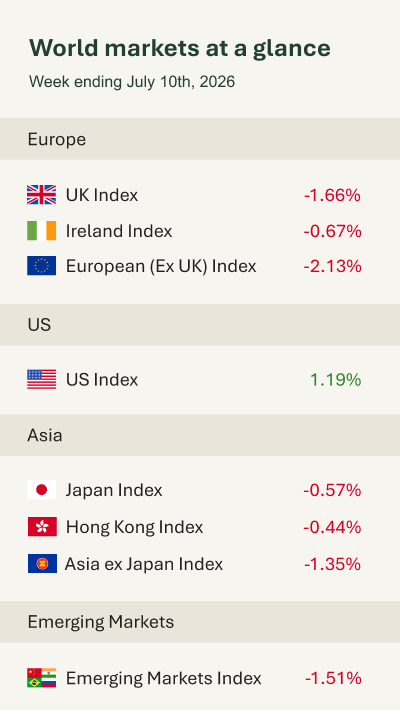
As shown in the accompanying table, markets closed the week on a mixed footing.

With economic data relatively light and investors awaiting the start of the second-quarter earnings season, it had been shaping up to be a relatively quiet week. However, markets were once again forced to navigate a fresh bout of geopolitical uncertainty as tensions between the United States and Iran intensified. On Wednesday, US President Donald Trump declared the ceasefire agreement with Iran to be over, stating at the NATO summit in Turkey that he “didn’t want to deal with them anymore”.

The collapse of the ceasefire and renewed military exchanges raised concerns that the conflict could escalate further and disrupt global energy supplies. Iran resumed attacks on commercial shipping in the Strait of Hormuz, while the US launched additional strikes and tightened sanctions on Iranian oil exports. These developments briefly pushed oil prices (Brent Crude) around 5% higher to approximately $80 per barrel before settling at $76 by Friday. However, it is worth noting that crude prices remain significantly below the highs of $120 reached earlier in the year and only modestly above pre-conflict levels.

While recent developments have unsettled investors, they have not come as a major surprise. This type of brinkmanship is characteristic of President Trump’s negotiating style, and markets have already weathered several cycles of escalation and de-escalation this year. Despite the geopolitical noise, equity markets have delivered strong returns and demonstrated notable resilience. Oil prices have also retreated, remaining within a historically normal range and providing some short-term relief.

Based on how the conflict has evolved so far, further periods of heightened tensions and renewed fighting before another ceasefire would not be surprising. As we often remind investors, periods of market dislocation can create attractive opportunities for those with a long-term investment horizon. This year’s events have reinforced the view that geopolitical uncertainty, while unsettling in the short term, is not something long-term investors should fear.

US equities proved resilient despite the geopolitical backdrop. After a volatile start to the week, a strong rebound in semiconductor and artificial intelligence-related shares lifted sentiment and allowed the major indices to recover. Over the week, the technology-heavy Nasdaq Composite led the gains, rising 1.74%, while the S&P 500 advanced 1.23%.

Investors also digested the minutes from the Federal Reserve’s June meeting, which revealed differing views among policymakers regarding the path of interest rates. While a handful of officials saw a case for raising rates, the committee ultimately opted to keep policy unchanged. The minutes highlighted significant uncertainty surrounding the economic outlook and suggested the Fed is becoming less inclined to signal future rate cuts, reinforcing the view that interest rates may remain higher for longer.

The prospect of renewed tensions between the US and Iran, or at the very least a fresh blockade of Iranian oil exports, triggered a wave of selling across European equities, which are particularly exposed to higher energy costs. The STOXX Europe 600 Index fell 1.79%, while the UK’s FTSE 100 retreated by 1.70%.

In the UK, political developments also attracted attention after Labour MPs overwhelmingly backed Andy Burnham to succeed Sir Keir Starmer as party leader. Markets will be watching closely for any indication of policy changes and fiscal discipline as the leadership transition progresses over the coming weeks.

Looking ahead, geopolitical developments remain a source of market volatility, although investors appear less reactive to headlines than earlier in the year, reflecting confidence that any disruption to energy markets is likely to prove temporary. Market attention is likely to shift towards second-quarter earnings. Major US banks, including JPMorgan Chase, Goldman Sachs and Bank of America are due to report next week.

Technology investors will also be watching Taiwan Semiconductor Manufacturing Company, ASML and Netflix for signs that AI-related spending remains robust, alongside updates on subscriber growth and advertising trends.

The economic calendar is busy, with US CPI and PPI inflation data, Chinese GDP, industrial production and retail sales for further clues on the health of the global economy.

Kate Mimnagh, Portfolio Economist

The latest market updates are brought to you by Investment Managers & Analysts at Wealth at Work Limited which is a member of the Wealth at Work group of companies.

Links to websites external to those of Wealth at Work Limited (also referred to here as 'we', 'us', 'our' 'ours') will usually contain some content that is not written by us and over which we have no authority and which we do not endorse. Any hyperlinks or references to third party websites are provided for your convenience only. Therefore please be aware that we do not accept responsibility for the content of any third party site(s) except content that is specifically attributed to us or our employees and where we are the authors of such content. Further, we accept no responsibility for any malicious codes (or their consequences) of external sites. Nor do we endorse any organisation or publication to which we link and make no representations about them.