
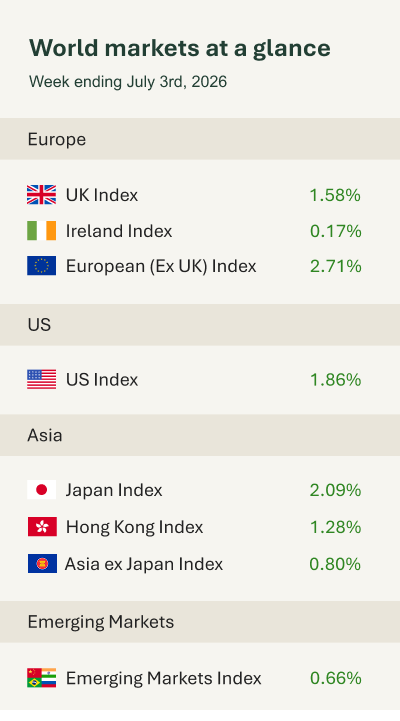
Week ending 3rd July 2026.

Global equity markets delivered a positive performance during the holiday-shortened week, supported by easing inflation pressures in Europe, a soft US labour market report and resilient economic data from China.

Markets rebounded at the start of the week, led by a recovery in technology stocks after the previous week’s pullback, as investors took profits. Investor sentiment improved as oil prices continued to retreat from recent highs, as Iran agreed to pause fighting and maintain commercial shipping through the Strait of Hormuz. Easing concerns that geopolitical tensions in the Middle East would significantly disrupt global growth or reignite inflation.

U.S. equity markets posted modest gains before markets closed on Friday for the Independence Day holiday.

Softer U.S. employment data reminded investors that economic growth is beginning to moderate. The main focus was June’s employment report, which showed the U.S. economy added just 57,000 jobs, well below expectations of around 110,000 and the weakest monthly reading since February’s contraction. Revisions to previous months also pointed to a slower labour market, with May payroll growth revised down to 129,000 and April to 148,000. Despite weaker hiring, the unemployment rate edged lower to 4.2%, however, this was due to 720,000 people leaving the labour force, which pushed down the participation ‌rate.

The softer labour market data reinforced expectations that the Federal Reserve may take a more cautious approach to interest rates. Markets reacted positively to the release, with investors increasingly anticipating that policymakers will remain on hold while monitoring economic conditions. As a result, expectations for a July rate increase fell significantly during the week, while the probability of a December rate hike declined to around 50%.

US manufacturing data also reflected a slowing but still expanding economy. The ISM Manufacturing PMI eased to 53.3 in June from 54.0, marking the sixth consecutive month of expansion. While new orders and production moderated, activity remained above the key 50 level. Encouragingly, the prices paid component declined sharply, suggesting inflationary pressures within the manufacturing sector continue to ease.

UK and European markets enjoyed a strong week. The FTSE 100 gained 1.38%, whilst revised data confirmed that the economy expanded by 0.6% during the first quarter of 2026, highlighting continued resilience despite higher borrowing costs and ongoing global uncertainty.

European markets closed the week up over 2%. Economic data wise, eurozone inflation fell in June to 2.8% on year from 3.2% in May. The figure came in below market expectations of 3.0% and marks the lowest rate since before the US-Iran war. Energy inflation eased significantly, alongside services price growth. Whilst the figure data is still above the 2% target, it alleviates pressure on European Central Bank policymakers to raise interest rates again this month.

Chinese equity markets performed well over the week. Sentiment was supported by stronger than expected manufacturing data and improved liquidity conditions, but weakness in global technology stocks later weighed on semiconductor and AI-related shares.

China’s official manufacturing PMI rose to 50.3 in June from 50.0 in May, signalling a return to expansion and reflecting stronger production and new orders. The non-manufacturing PMI also edged up to 50.2, indicating stable economic activity despite ongoing property market and domestic demand challenges.

Looking ahead, attention will turn to the start of the Q2 earnings season, alongside key economic releases including Eurozone retail sales, the US ISM PMI, and US trade data. Investors will also closely watch the minutes from the Federal Reserve’s June meeting for further insight into the outlook for interest rates, following Chair Kevin Warsh’s comments at the post-meeting press conference.

Kate Mimnagh, Portfolio Economist

The latest market updates are brought to you by Investment Managers & Analysts at Wealth at Work Limited which is a member of the Wealth at Work group of companies.

Links to websites external to those of Wealth at Work Limited (also referred to here as 'we', 'us', 'our' 'ours') will usually contain some content that is not written by us and over which we have no authority and which we do not endorse. Any hyperlinks or references to third party websites are provided for your convenience only. Therefore please be aware that we do not accept responsibility for the content of any third party site(s) except content that is specifically attributed to us or our employees and where we are the authors of such content. Further, we accept no responsibility for any malicious codes (or their consequences) of external sites. Nor do we endorse any organisation or publication to which we link and make no representations about them.