

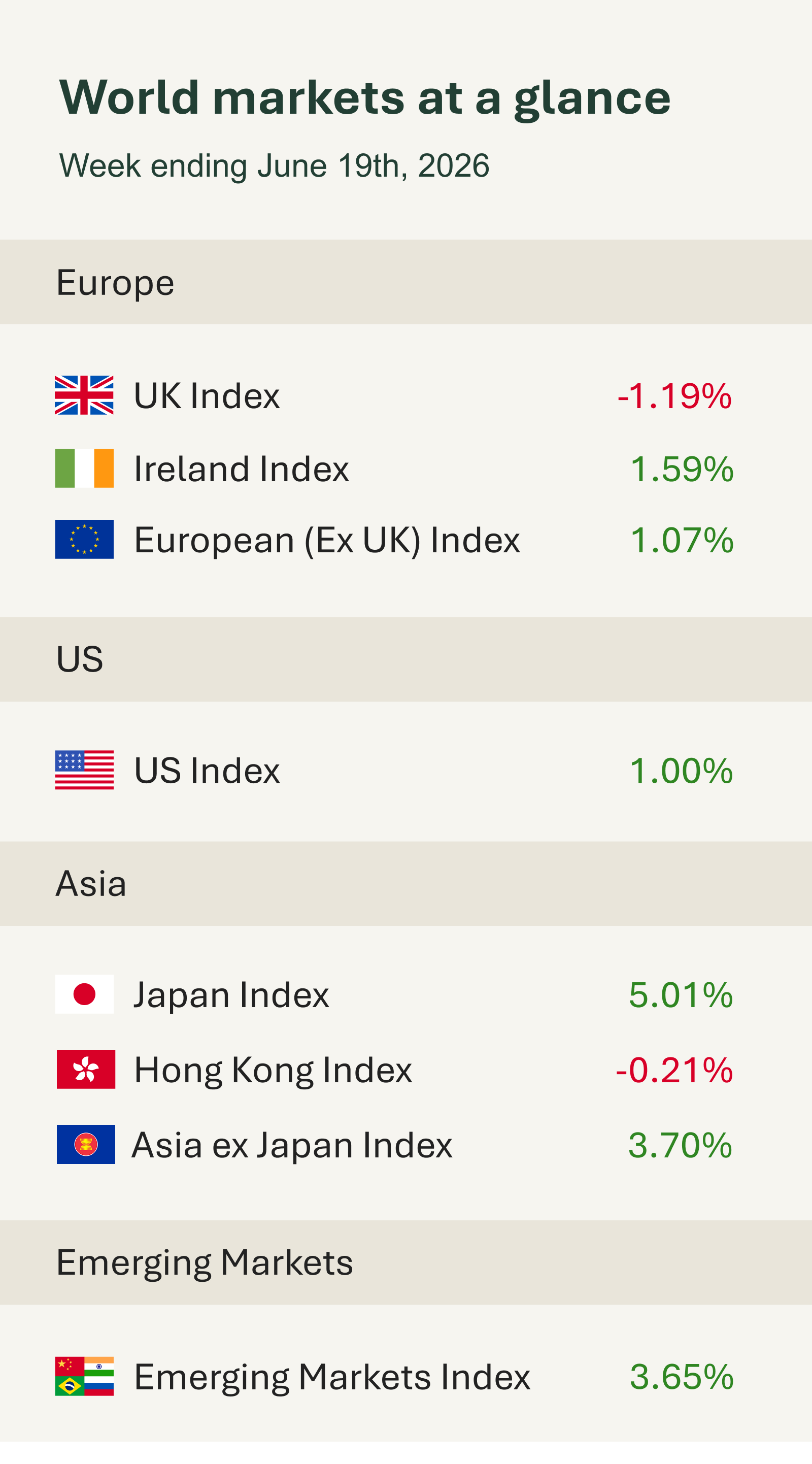
As you can see from the accompanying table, it was positive week for global financial markets following the signing of the Memorandum of Understanding last week between the US and Iran which includes a commitment to reach a final deal within 60 days, as well as an end to fighting on all fronts and the reopening of the Strait of Hormuz.
Markets started the week on an optimistic footing, as investors anticipated the formal signing of a US–Iran agreement scheduled for Friday. Brent crude drifted lower, dipping below $80/bbl and sentiment was further supported by reports that tanker traffic through the Strait of Hormuz had resumed. The reopening of the Strait is particularly significant for markets, given its importance as a key global energy route. That being said infrastructure repairs, particularly to LNG facilities, may take time, and output via the Strait could initially recover to around 70% of pre-conflict levels, with producers continuing to rely on alternative export routes.
Also this week, Federal Reserve delivered its interest rate decision on Wednesday, marking the first meeting chaired by Kevin Warsh. Policymakers voted unanimously to hold the federal funds rate 3.50–3.75% as expected.
However, officials appear split on whether future rates should remain on hold or be increased further to tackle inflation, which is currently running at 4.2% (May 2026).
Warsh, who has been critical of the Fed’s prior communication approach, delivered a very brief statement reflecting his preference for limited forward guidance. Yet it was not his briefness that unsettled markets rather it was the removal of a long-standing statement hinting that policymakers were leaning towards lowering interest rates. This marked a shift from March, when the committee’s projections showed no policymakers anticipating further rate hikes. Since then, however, persistently strong inflation and a resilient labour market have altered the outlook.
The FTSE 100 declined over the week, weighed down by political uncertainty and sector‑level weakness, with mining stocks leading the losses.
Data-wise, UK unemployment edged down to 4.9% in the three months to April, slightly better than expected, however, this progress masks weakening underlying dynamics. Hiring has slowed sharply, with new entrants to payrolls at a five-year low.
Wage growth remains relatively firm, with average pay excluding bonuses rising 3.4% annually in the three months to April, still above inflation. However, this strength is largely driven by the public sector, where annual wages rose 5.1% versus 2.9% in the private sector, complicating the Monetary Policy Committee’s assessment. Policymakers will be noting signs wage disinflation may be stalling, which risks supporting stronger household spending and delaying inflation’s return to target.