

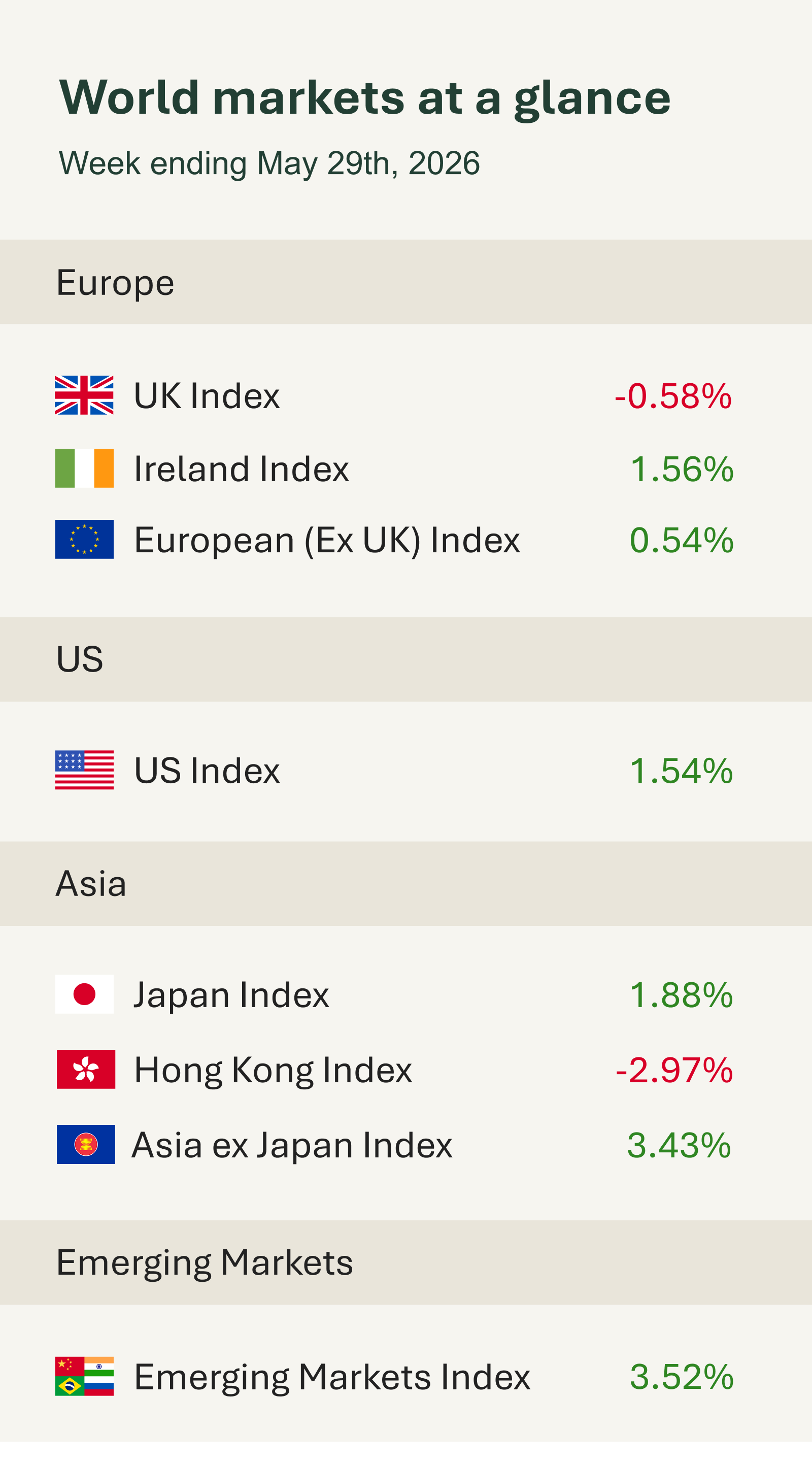
As shown in the accompanying table, market performance was mixed over the week, with strong gains in the US contrasted by more subdued results across the UK, and the wider European markets.
It was a holiday-shortened week, with both UK and US markets closed on Monday for the late May bank holiday and Memorial Day. Investor focus remained firmly on geopolitical developments and the ongoing earnings season.
US stocks reached new highs over the week, supported by progress in peace talks and continued momentum in AI-driven technology shares.
According to reports, a new peace proposal has been drafted between the US and Tehran that would extend the current ceasefire by 60 days and allow commercial shipping to resume through the Strait. Vice President JD Vance stated that, while the agreement has not yet been formally approved by President Trump, both sides are continuing to work through several outstanding issues, including concerns surrounding Tehran’s alleged stockpile of enriched uranium. Both Asian and US markets reacted positively to the developments, while oil prices also trended lower. Brent crude has fallen by nearly 19% since the start of May, easing to around $92 per barrel by Friday. This decline has helped temper inflation concerns and contributed to a modest pullback in government bond yields, as investors scale back expectations for further monetary tightening. For now, the key takeaway is that discussions are ongoing, suggesting a potential path toward resolution. From a market perspective, the most critical issue remains the reopening of the Strait of Hormuz, given its importance for global energy flows.
Japan’s equity markets also hit record highs, with gains driven by easing Middle East tensions as the US and Iran moved toward extending a ceasefire and advancing nuclear negotiations, positive for Japan’s energy-dependent economy. Technology and AI-related stocks led the rally, with semiconductor and electronics companies benefiting from renewed demand and reduced supply chain concerns.
US personal consumption expenditures (PCE) inflation was the focal data release for markets, given its status as the Federal Reserve’s preferred gauge of price pressures. The latest figures underscored the ongoing tension between persistent inflation and a monetary policy stance that remains cautious. Headline PCE rose 3.8% year-on-year in April 2026, in line with expectations. The increase was driven by higher energy costs, reflecting geopolitical tensions in the Middle East and elevated oil prices.