

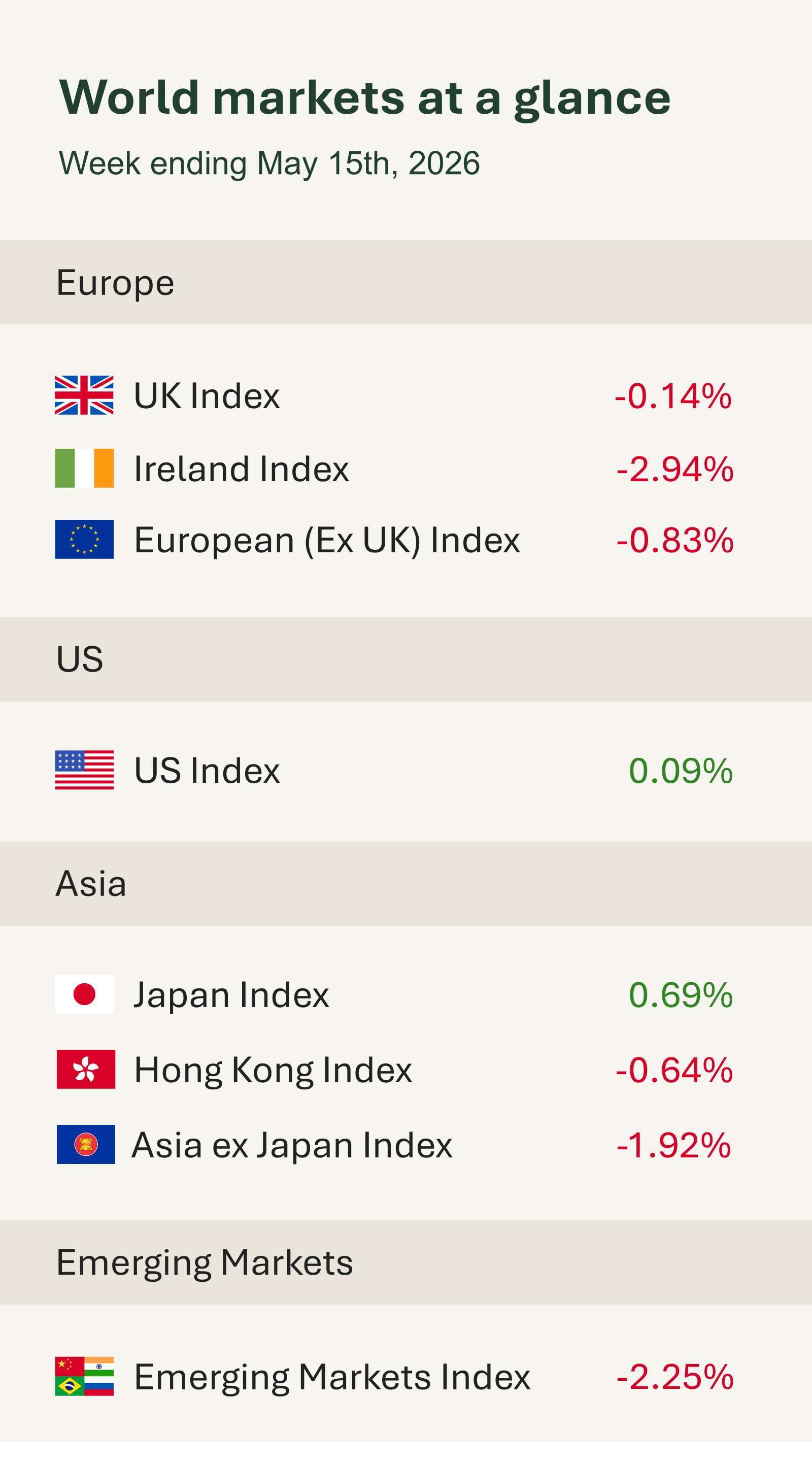
As you can see from the accompanying table markets experienced a more volatile week as investors balanced political developments in the UK, Middle East tensions and ongoing concerns around inflation and interest rates. Part of this week’s weakness appears to also reflect some profit-taking, following strong market performance following a robust first-quarter earnings season, in which many companies continued to deliver solid results despite an uncertain backdrop.
Q1 earnings season has provided a strong tailwind for U.S. equity markets, helping to sustain positive momentum in recent weeks. With 91% of S&P 500 companies having reported results, earnings have broadly exceeded expectations, with 84% delivering positive EPS surprises and 80% reporting revenue beats. The resilience of corporates have reinforced investor confidence in the U.S. economy and supported continued strength across equity markets.
Markets monitored the summit between U.S. President Donald Trump and Chinese President Xi Jinping this week. While the meeting did not deliver any major breakthroughs, investors were reassured by the absence of further escalation between the world’s two largest economies. Both sides signalled a willingness to continue dialogue on trade and economic cooperation, helping to stabilise broader market sentiment.
Turning to the UK, preliminary data revealed that the economy grew by 0.6% in Q1 2026, in line with expectations and up from 0.2% in Q4 2025, driven by services, notably retail, wholesale, and computer programming. This points to solid near-term resilience.
Growth in March surprised to the upside, rising 0.3% versus expectations of a contraction. However, underlying signals are more mixed. Consumers may be starting to curb discretionary spending amid concerns over rising inflation, particularly linked to energy costs. Businesses are also facing renewed pressure, with input prices rising sharply and job vacancies continuing to decline, hinting at softer demand ahead. While retail sales and PMIs remain relatively firm, some strength may reflect front-loaded spending ahead of further price increases. Overall, the data is reassuring for now, but risks point to a moderation in growth over coming quarters.
Political uncertainty was a focal point in the UK. UK government borrowing costs rose, with the 10-year gilt yield briefly rising above 5.17% on Friday. The pound also weakened against the U.S. dollar, while UK equities ended the week slightly lower. Much of the noise was driven by political uncertainty surrounding Prime Minister Keir Starmer’s leadership following Labour’s disappointing local election results and speculation that Greater Manchester Mayor Andy Burnham could potentially challenge leadership.