
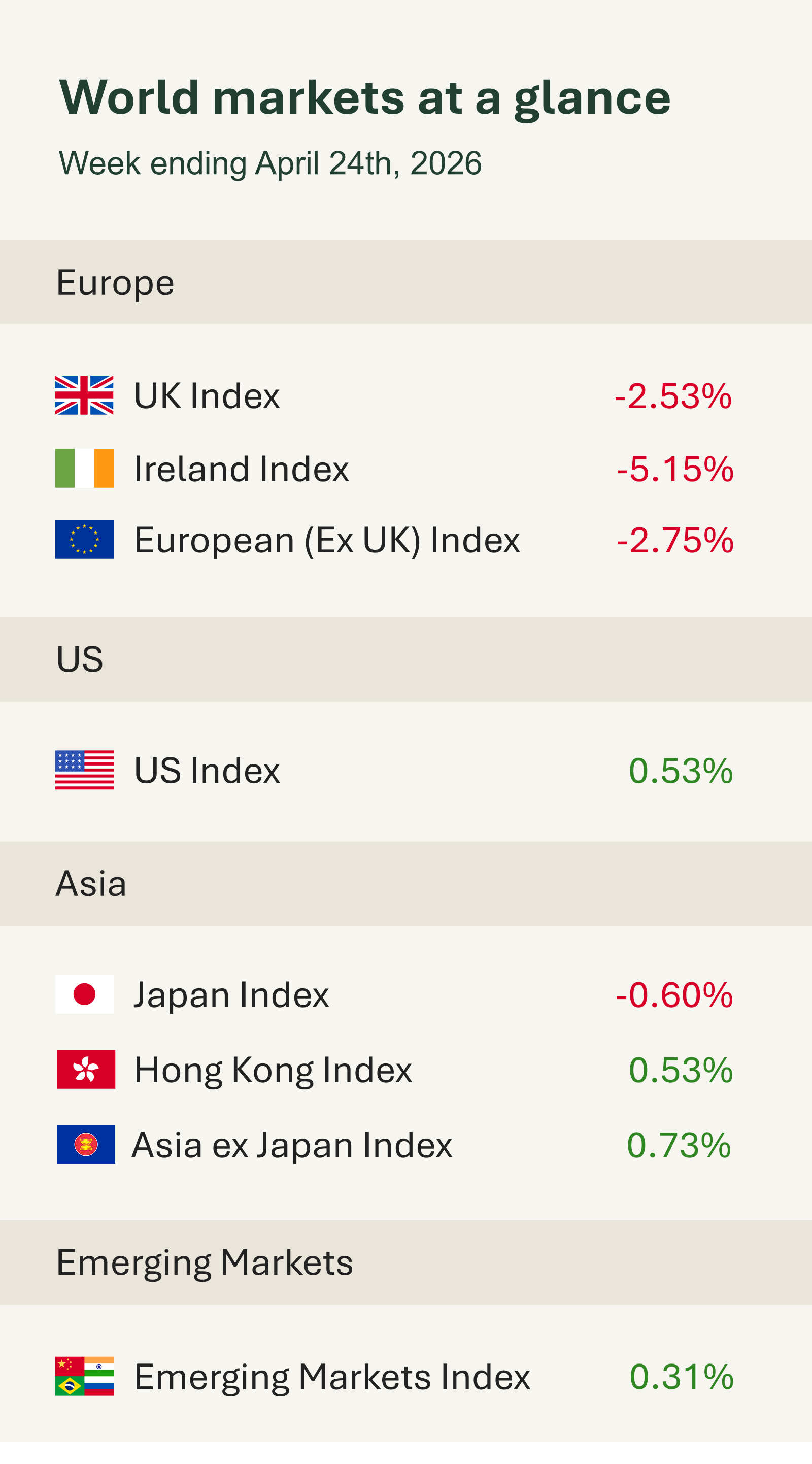
week ending 24th April 2026.

As shown in the accompanying table, returns were mixed this week. Markets navigated a complex backdrop dominated by ongoing geopolitical tensions in the Middle East.

Markets started the week more cautiously after a strong three‑week rally, as hopes for a rapid de‑escalation in the U.S.–Iran conflict faded. Concerns around energy supply routes, particularly the Strait of Hormuz, weighed on sentiment. However, midweek optimism improved following an extension of ceasefire arrangements, allowing equities to recover some ground despite the fragile geopolitical backdrop. Oil prices remained elevated, with Brent crude rising back above $100 per barrel and touching over $106 on Friday.

While headlines remain concerning, markets have again shown resilience, reflecting their tendency to look through short-term uncertainty and focus on the longer-term economic outlook.

April has, in fact, been a positive month for global equities, supported by ceasefire agreements elsewhere in the region and improving sentiment around the longer-term prospects for stabilisation. The start of the corporate earnings season has also provided important support for markets.

U.S. markets have led much of this recovery, particularly within the technology sector. The Nasdaq index has risen almost 15% since the end of March, rebounding sharply after previously being down more than 7%. This recovery reflects continued confidence in corporate earnings, especially among large technology and semiconductor companies that remain central to the artificial intelligence investment theme.

Closer to home, the UK economic picture has softened slightly following a stronger-than-expected start to the year. Retail sales increased by 0.7% in March compared with the previous month, ahead of expectations for a 0.1% rise. However, this increase was driven largely by higher fuel spending and stronger non-food purchases, with retail sales excluding fuel rising by just 0.2% over the month. Unemployment fell unexpectedly in the three months to February, although much of this improvement reflected lower workforce participation rather than stronger hiring. Consumer confidence also weakened sharply, reaching its lowest level since late 2023, suggesting that households remain cautious despite signs of improving spending data.

Within the Bank of England, policymakers continue to strike a careful balance between managing inflation risks and supporting economic growth. Governor Andrew Bailey has reiterated the importance of maintaining a measured, data-dependent approach, rather than rushing towards either aggressive rate cuts or further tightening.

Encouragingly, recent business surveys suggest the UK economy remains subdued but stable rather than deteriorating. Manufacturing activity improved meaningfully in April, with the PMI rising to 53.6, its strongest reading since mid-2022, while services activity also improved modestly. Businesses continue to invest selectively in technology, marketing, and longer-term strategic initiatives, although concerns around inflation, geopolitical uncertainty, and supply chain disruption persist.

Our UK exposure remains focused on large, globally diversified FTSE 100 businesses, many of which generate 70–75% or more of their revenues overseas. This significantly reduces reliance on domestic UK economic conditions and provides access to high-quality international companies with resilient long-term fundamentals.

Looking ahead, the coming week will be pivotal for global central banks, with policy decisions due from the Bank of Japan, Bank of Canada, European Central Bank, and Bank of England. Policymakers are widely expected to remain cautious, as inflationary pressures continue to prove sticky and geopolitical risks weigh on the global outlook.

In Europe, investor focus will also turn to eurozone inflation and GDP data, particularly following weaker confidence indicators from Germany and France earlier this week.

The Federal Reserve will take centre stage on Wednesday, with markets firmly expecting interest rates to be left unchanged in the 3.50%–3.75% range.

Corporate earnings will remain a key driver for markets, especially within the technology sector. Results from Microsoft, Meta Platforms, Alphabet, Amazon, and Apple are set to dominate investor attention, with a particular focus on capital expenditure plans and whether current investment levels continue to justify elevated market expectations.

Kate Mimnagh, Portfolio Economist

The latest market updates are brought to you by Investment Managers & Analysts at Wealth at Work Limited which is a member of the Wealth at Work group of companies.

Links to websites external to those of Wealth at Work Limited (also referred to here as 'we', 'us', 'our' 'ours') will usually contain some content that is not written by us and over which we have no authority and which we do not endorse. Any hyperlinks or references to third party websites are provided for your convenience only. Therefore please be aware that we do not accept responsibility for the content of any third party site(s) except content that is specifically attributed to us or our employees and where we are the authors of such content. Further, we accept no responsibility for any malicious codes (or their consequences) of external sites. Nor do we endorse any organisation or publication to which we link and make no representations about them.