

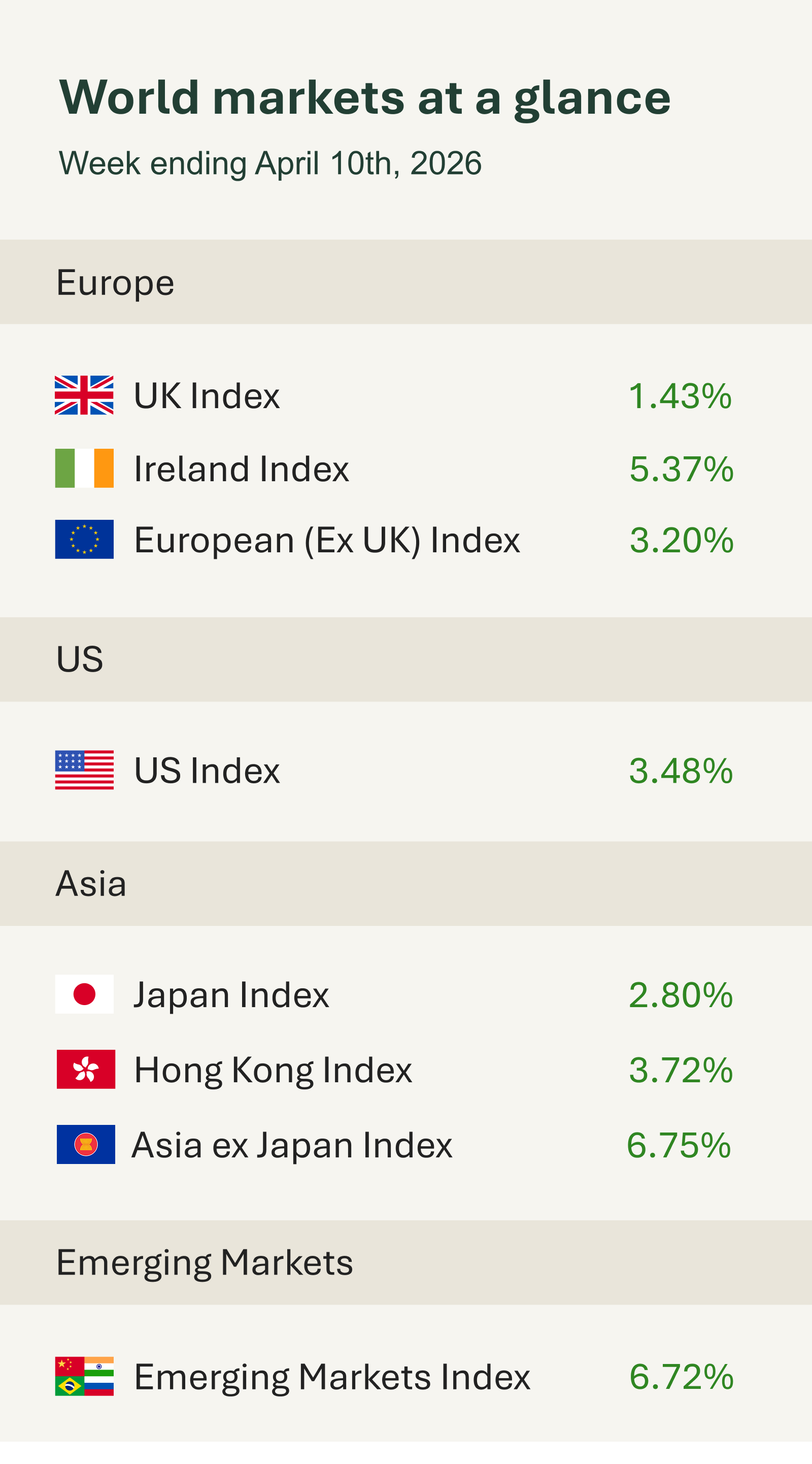
As shown in the accompanying table, financial markets experienced a notably more positive week, supported by improving sentiment following the announcement of a ceasefire agreement between the United States and Iran. While the agreement, conditional on the reopening of the Strait of Hormuz, remained fragile, markets responded positively to signs of de-escalation.
In the U.S., major indices closed the week strongly higher, with gains of over 3% across the board, led by the Nasdaq Composite, which rose 4.68%. European markets also performed well, with the STOXX Europe 600 up 3.05% and the FTSE 100 gaining 1.57%. In Asia, Japan’s Nikkei 225 surged over 7%, while Hong Kong’s Hang Seng Index rose 3.09%, reflecting a broad-based improvement in global risk sentiment.
The closure of this vital maritime route has been at the centre of recent market volatility, as disruptions to oil and gas flows from the region have driven global energy prices higher. However, the easing in tensions saw oil prices drift lower into the end of the week, closing around $97 per barrel. This helped support equity markets and highlighted how quickly sentiment can stabilise when risks begin to recede.
The agreement was already fragile ahead of U.S.–Iran negotiations in Pakistan over the weekend. Reports suggest the talks made limited progress, with the U.S. now signalling a potential blockade of Iranian ports. This has refocused attention on oil supply risks, supporting a modest rise in crude prices and contributing to a slightly weaker tone in equity markets into Monday morning.
Elsewhere data wise, U.S. inflation accelerated in March, with CPI rising 3.3% year-over-year, driven by higher gasoline prices. However, core inflation remained relatively stable, with core CPI at 2.6%.
The federal reserve’s key measure of inflation, Core PCE which indicates the underlying inflation in the US economy, rose 0.4% from the previous month in February 2026. In line with forecasts, however, inflation likely rose over the month of March, amid the war in Iran, the uncertainty of which led Federal Reserve policymakers to hold interest rates at their meeting.
Enthusiasm around artificial intelligence-linked stocks also boosted markets, with several large cap technology and semi-conductor stocks advancing. TSMC the world’s largest contract chipmaker, on Friday reported a 35% surge in first-quarter revenue, beating market forecasts, thanks to unabated interest in artificial intelligence applications. AI demand and innovation continue to be a key driver for markets.