

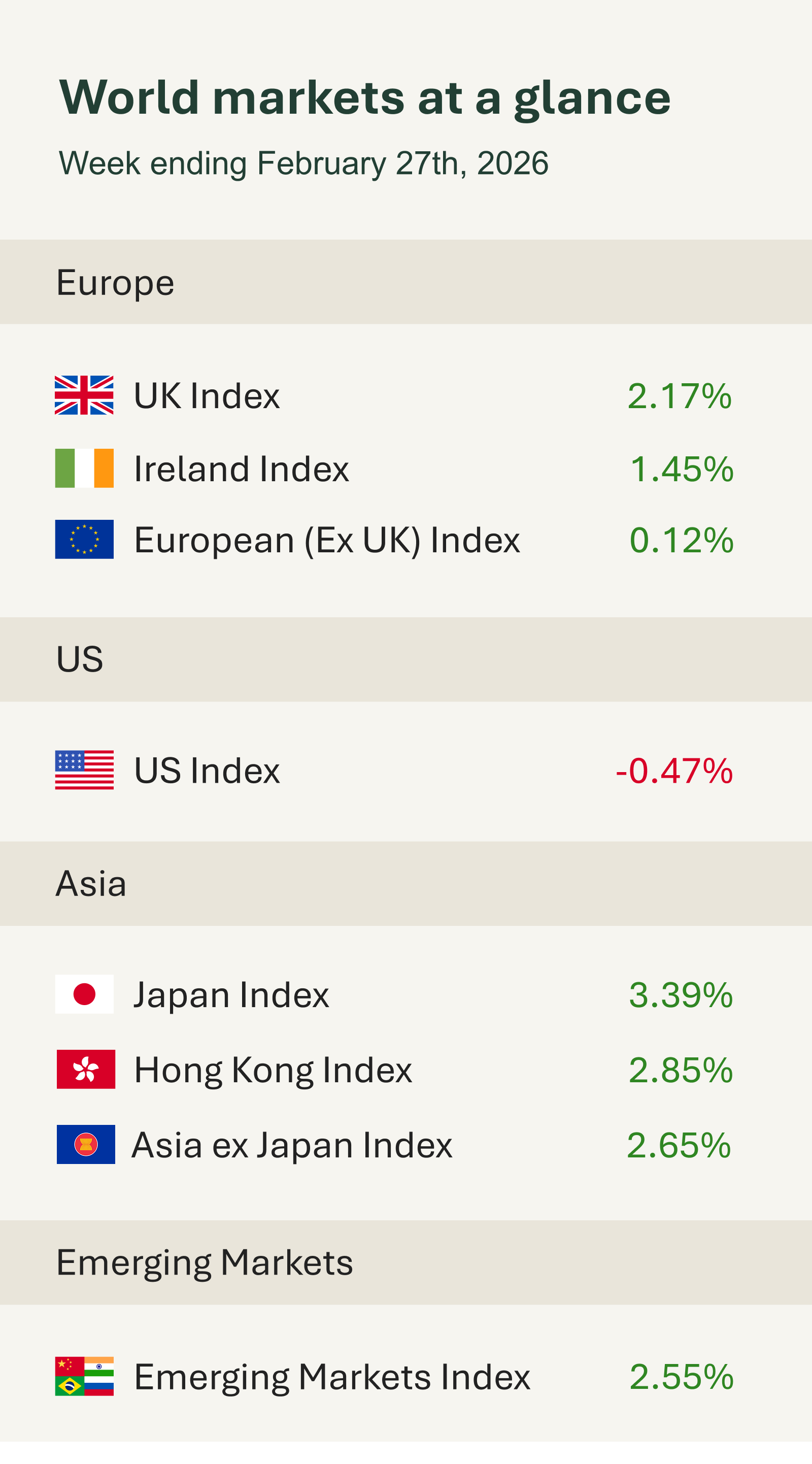
Global financial markets navigated a mixed and somewhat choppy landscape this past week as investors balanced robust corporate earnings against a complex backdrop of geopolitical developments and shifting expectations within the technology sector. While performance across February has been uneven, much of the recent caution has centred on the momentum within the artificial intelligence space and ongoing geopolitical dialogues. Markets have also been closely monitoring the evolving situation between the U.S. and Iran. (Please see our special update for more detail on the market response to developments that unfolded over the weekend.)
The midweek highlight was undoubtedly Nvidia’s quarterly earnings, which many investors treat as a barometer for the health of the entire AI sector. As a global leader in the semiconductors that power modern large language models and data centres, Nvidia’s influence on major indices like the S&P 500 is significant. Although the company delivered results that exceeded expectations and provided strong future guidance, the market response was relatively muted. This suggests we are entering a more mature phase of the AI cycle; rather than reacting solely to the potential of the technology, investors are now looking for tangible proof of how these significant infrastructure investments are translating into sustainable profitability. We view this shift as a healthy sign of market discipline, where high expectations are being met with a demand for fundamental earnings growth.
U.S. stocks moved sharply lower on Friday, with investors fearing that a hotter-than-expected inflation report could lead the Federal Reserve to keep its rate-cutting cycle on pause. The Producer Price Index (PPI), which measures the average change in prices that producers receive for their goods and services, is closely watched as a potential bellwether for the prices consumers may see in the months ahead. The January PPI rose by a stronger-than-expected 0.5%, while annual PPI inflation has softened slightly to 2.9%.
In contrast to the turbulence in the U.S. tech sector, UK and European markets demonstrated notable resilience, with several indices reaching record highs toward the end of the week. The FTSE 100 gained more than 2%, supported by strong performances from major domestic names. The London Stock Exchange Group advanced after announcing plans to return £3 billion to shareholders, while Rolls-Royce rallied sharply as it raised its mid-term targets following a very strong performance in 2025. Although UK consumer confidence edged slightly lower in February, largely reflecting concerns about rising unemployment this did little to offset the broader strength seen throughout the week.
Looking further afield, international sentiment remained largely positive. Japanese markets reached record highs as investors embraced the policy