

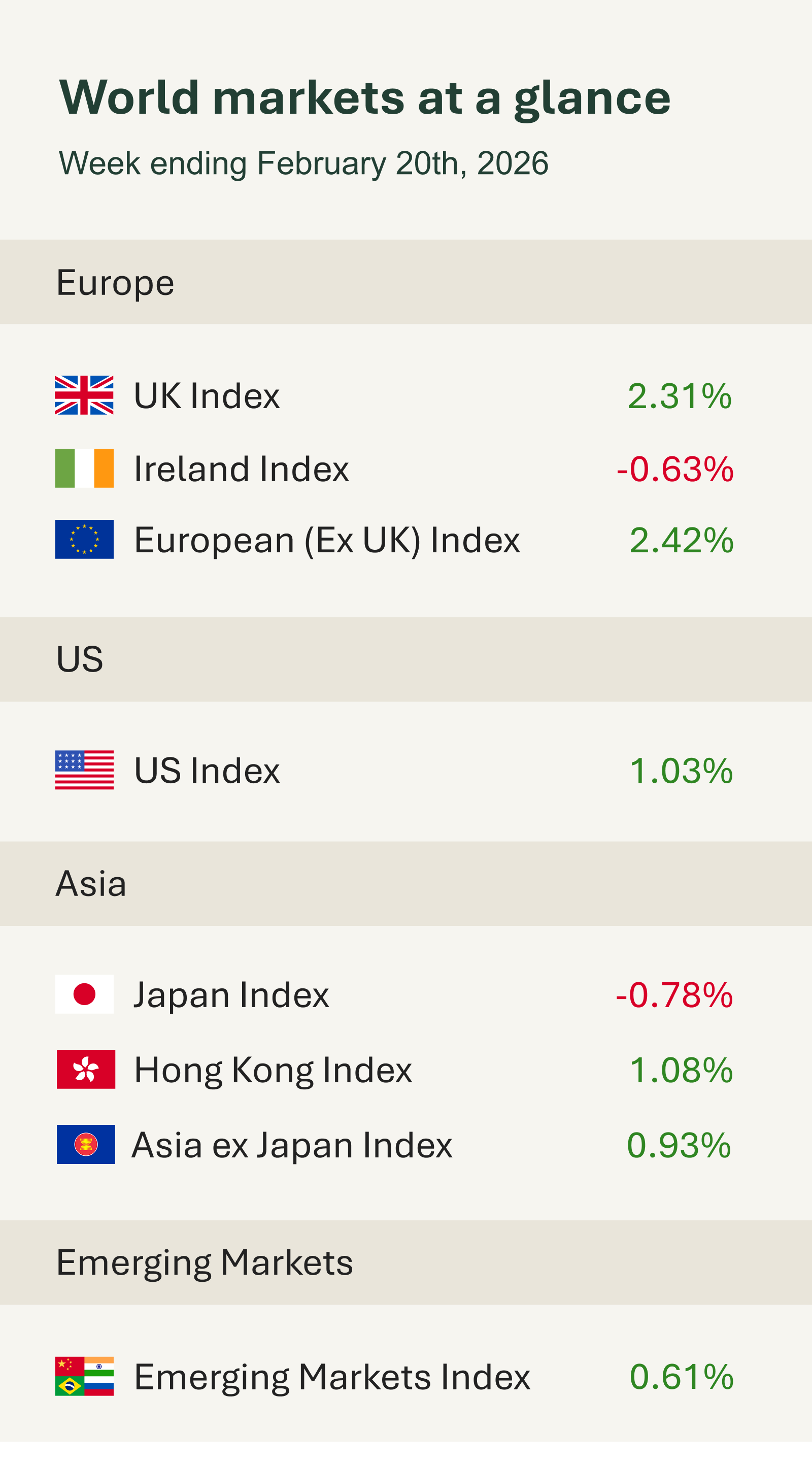
As you can see from the accompanying table, it was a positive week for global financial markets. Trading conditions were relatively quiet, however, as U.S. markets were closed on Monday in observance of Presidents’ Day, and volumes were further thinned by the Lunar New Year holiday across China. Despite the lighter participation, sentiment remained constructive, allowing equities to advance across most major regions.
U.S. equities rallied on Friday after the Supreme Court ruled that President Donald Trump exceeded his authority in imposing tariffs under the 1977 International Emergency Economic Powers Act (IEEPA). The decision invalidates tariffs enacted under that statute including certain reciprocal measures and tariffs on Canada, China, and Mexico, while leaving other trade‑law‑based tariffs intact.
More than $130 billion had been collected under IEEPA. While refunds to U.S. importers are possible, they are not automatic and will depend on further court proceedings. For markets, the ruling reduces trade policy uncertainty, lowers the risk of sweeping unilateral tariff actions, and may provide a modest tailwind for import‑sensitive sectors. Potential refunds could also offer a one‑time earnings boost for affected companies.
However, trade uncertainty is far from over, as President Trump announced on Saturday via Truth Social that he now intends to raise the levy to the maximum allowed under a little‑used trade statute. While the original 10% tariffs were due to take effect on Tuesday, 24 February, it remains unclear whether the higher 15% rate will also be implemented on that date.
Economic data painted a mixed picture. The Fed’s preferred inflation gauge, the Personal Consumption Expenditures (PCE) index, rose 0.4% month‑over‑month and 3.0% year‑over‑year in December, signalling some renewed price pressure. Headline PCE rose 2.9% year‑over‑year, its highest level since March 2024, reinforcing the view that progress on inflation remains uneven.
At the same time, U.S. GDP growth slowed to a 1.4% annualised pace in Q4, down from 4.4% in the prior quarter, as consumer spending softened and a federal government shutdown weighed on activity. Still, the economy expanded 2.2% in 2025 overall, demonstrating resilience despite tariffs, fiscal tightening, and persistent inflation.
For markets, the combination of slower growth and firm inflation supports a “higher‑for‑longer” interest rate narrative.
In the UK, inflation eased to 3.0% year‑over‑year in January, while unemployment rose to 5.2% and wage growth slowed.