
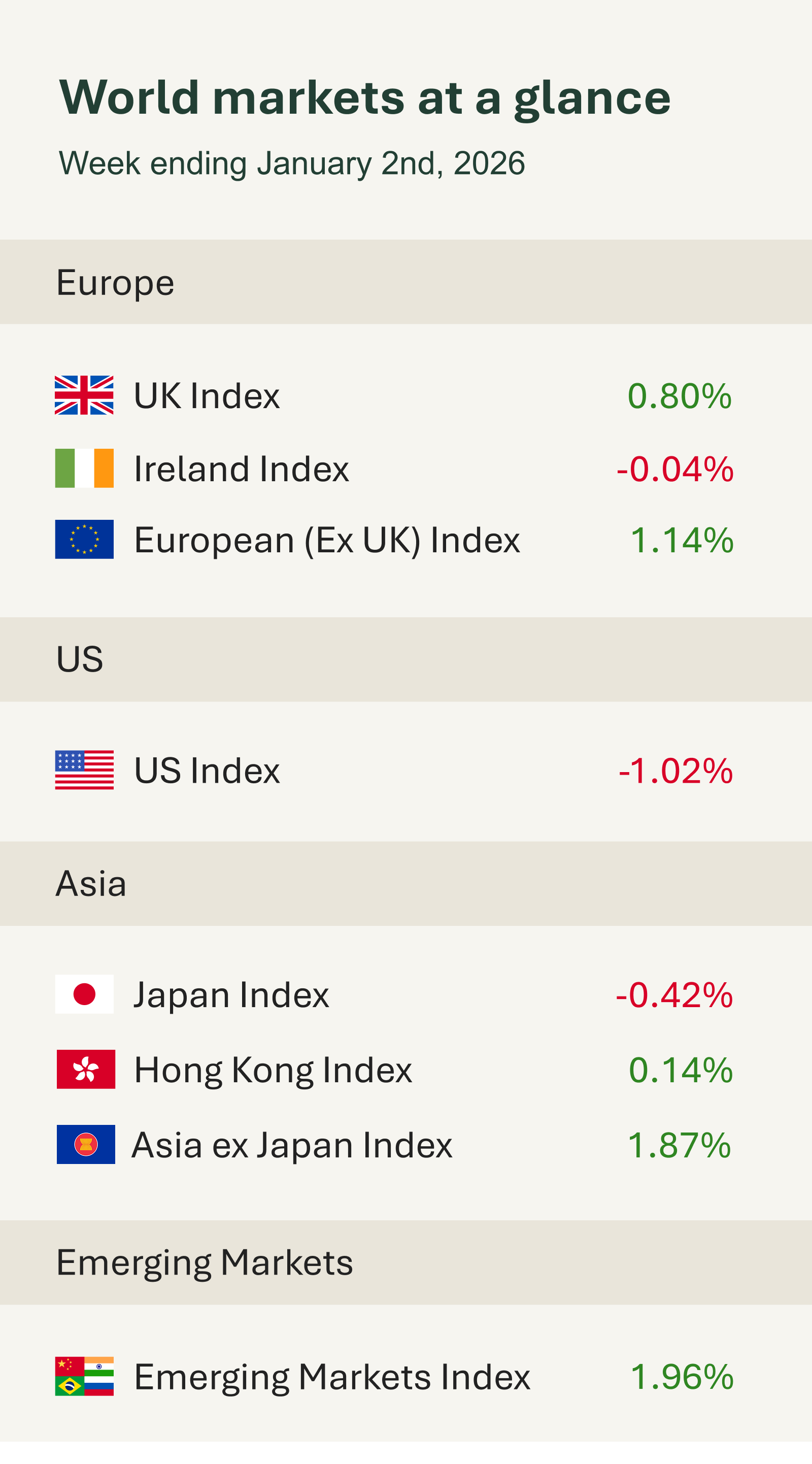
Week ending 2nd January 2026.

Trading volumes were thin over the Christmas and New Year period, with many major exchanges closed or operating on reduced hours. As a result, market activity was subdued, and price moves were generally modest.

Looking back, 2025 proved to be an exceptionally strong year for financial markets, despite several bouts of volatility along the way. Global equities delivered robust gains, with the FTSE All World Index rising close to 15% on a total return basis in sterling terms.

For UK investors in particular, the year stood out. The FTSE 100 recorded its best annual performance since 2009. Our portfolios have delivered double-digit returns, underlining the benefits of diversification and long-term discipline. Despite persistent geopolitical noise throughout the year and the shock back in April surrounding “Liberation Day”, markets recovered quickly and finished the year higher – an important reminder of the value of staying invested and not reacting to short-term market turbulence.

On the macro front, economic data releases were relatively quiet. Investor attention focused mainly on China’s PMI data and the minutes from the Federal Reserve’s December policy meeting.

Data from China’s manufacturing sector returned to growth toward the end of the year. The official manufacturing PMI rose to 50.1 in December from 49.2 previously, moving back into expansionary territory. Policy developments in China drew attention as well. Authorities reportedly instructed chipmakers to source at least 50% of equipment for new capacity from domestic suppliers, reinforcing efforts to achieve semiconductor self-sufficiency. In addition, Beijing announced measures to support domestic demand, including a VAT cut on homes sold within two years and an initial $9 billion allocation for consumer subsidies in 2026, aimed at stabilising consumption and underpinning growth.

Meanwhile, minutes from the Federal Reserve’s December meeting revealed that the decision to cut interest rates was highly contentious. While most participants ultimately supported the cut as a forward-looking step to help stabilise the labour market amid slowing job growth, several officials described the decision as “finely balanced”. Six policymakers opposed the cut outright, with two dissenting votes recorded. Concerns focused on the lack of clear progress toward the Fed’s 2% inflation target, and some members suggested holding rates at the new range for an extended period. The data catch-up continues, with December jobs and consumer price figures due on January 9 and January 13, returning the calendar to its normal release schedule. The Fed next meets at the end of January, with markets currently expecting rates to remain unchanged.

Looking ahead, the coming week brings a fuller slate of economic releases, including:

US ISM manufacturing and services PMIs, Eurozone inflation and economic sentiment. Later in the week Chinese inflation, Eurozone retail sales. Data on the US labour market including non-farm payrolls, initial jobless claims, unemployment, and average earnings.

Nicola Tune, Portfolio Specialist

The latest market updates are brought to you by Investment Managers & Analysts at Wealth at Work Limited which is a member of the Wealth at Work group of companies.

Links to websites external to those of Wealth at Work Limited (also referred to here as 'we', 'us', 'our' 'ours') will usually contain some content that is not written by us and over which we have no authority and which we do not endorse. Any hyperlinks or references to third party websites are provided for your convenience only. Therefore please be aware that we do not accept responsibility for the content of any third party site(s) except content that is specifically attributed to us or our employees and where we are the authors of such content. Further, we accept no responsibility for any malicious codes (or their consequences) of external sites. Nor do we endorse any organisation or publication to which we link and make no representations about them.